
Let us start with a scenario most Indian sales managers will recognise.
It is 3:30 pm on a Tuesday. You have a field team of twelve. One of them has not checked in since morning. A key distributor just called saying nobody showed up for the scheduled visit. You open your WhatsApp and start typing. You wait. You call. You get a “yes sir, on my way” with no further context. By the time you piece together what happened, the distributor has already moved on with his afternoon.
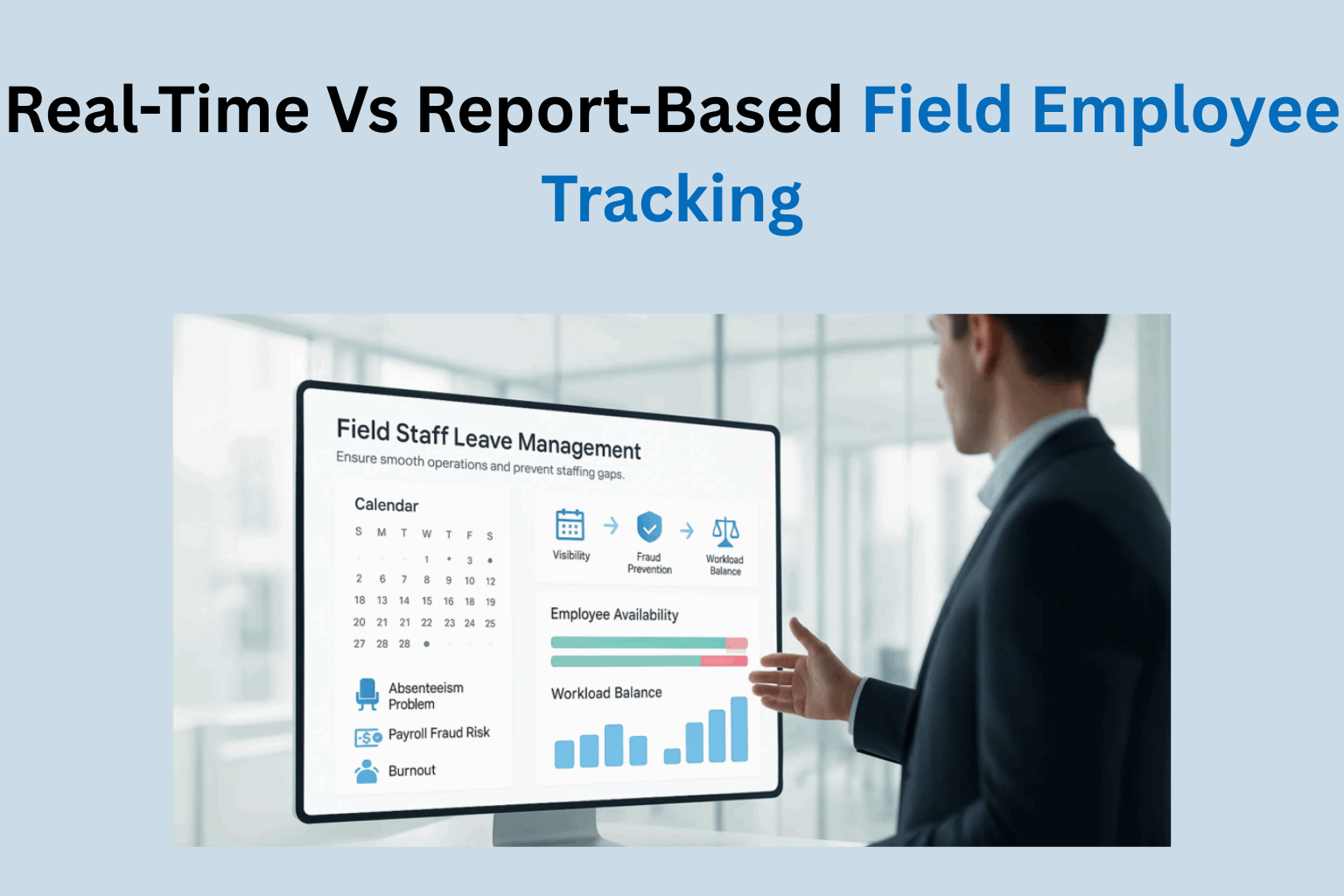
This is not a trust problem. This is an information problem. And the answer to it sits at the centre of a debate that most organisations running field teams have not actually resolved: do you manage your people through real-time field employee tracking, or do you rely on the reports they submit at the end of the day?
Both exist. Both are used widely across Indian businesses. Only one of them gives you the ability to act while there is still time to act.
The report-based system: what it is, what it does well
Report-based tracking is the default for most Indian field operations. Sales executives fill in a daily visit report. Service technicians submit a job completion log. Field reps share a summary at 6 pm detailing who they met, what was discussed, and what the next step is.
It is not a bad system. In fact, for certain things it is quite good.
Reports create a written record. They encourage field staff to reflect on their day and articulate what happened. A well-structured daily report can surface intelligence that pure location data would never capture – a distributor’s objection, a competitor’s new promotion, a pricing complaint from three different accounts in the same town.
The problem is the tense. Reports are always past tense. By the time a manager reads them, the day is over. The decisions that could have been made at 11 am – reroute this executive, send backup to that account, cover the gap in this territory – are no longer available. The window has closed. All you can do is note what went wrong and hope tomorrow is different.
Where report-based tracking quietly fails
There is a subtler failure mode that rarely gets discussed. When field staff know that their reporting is the only accountability mechanism, the reports become the job. Not the actual work. The job.
A well-written daily report that covers for a poorly-spent day is easy to produce. Most experienced field executives know how. They have visited the same accounts enough times to write convincingly about conversations that were shorter than they appear on paper. The manager reads the report, feels informed, and makes plans based on data that is at least partially constructed.
Nobody announces this. It just happens. Gradually. And the organisation starts managing a narrative of field activity rather than the activity itself.
What real-time field employee tracking actually changes
Real-time field employee tracking does not replace reports. It changes what reports are for.
When a manager can see, at any point during the day, where every field executive is on a map – which accounts they have visited, how long they stayed, whether they deviated from the planned route – the daily report shifts from an accountability document to an intelligence document. The manager already knows the facts. The report adds context to the facts.
That is a fundamentally different relationship between a manager and their team. Less policing. More coaching.
Here is what real-time visibility allows that report-based systems structurally cannot:
- Intraday course correction – A manager sees at 1 pm that an executive finished their morning visits early and is sitting idle in a café. They assign an additional call two kilometres away. The afternoon is recovered. With a report-based system, the idle afternoon shows up in tomorrow’s numbers, not today’s decisions.
- Territory coverage gaps spotted immediately – If three executives are clustered in one area while a priority zone is uncovered, the map shows it. The moment it is happening, not a week later in a review meeting.
- Genuine visit verification – When the system logs that a rep was at a client location for eleven minutes, that context sits alongside their report entry of a “detailed product discussion.” Managers learn quickly what eleven-minute visits tend to produce.
- Dispute resolution with data – Expense claims, mileage reimbursements, and client billing disputes all become significantly less ambiguous when there is a timestamped, geotagged record of where someone was and for how long.
- New joiner oversight without micromanagement – A new field executive operating in an unfamiliar territory gets guidance from the system. A manager can nudge them toward undercovered accounts without a daily call.
The objection that always comes up
At this point, someone in every organisation raises the same concern. It feels like surveillance. Field staff will resist it. It will damage trust.
This is worth taking seriously. Not dismissing.
The distinction that matters is purpose. Tracking systems implemented as a punitive measure – “we will catch you if you slack off” – do damage morale. That is a management decision, not a technology problem. Tracking systems implemented as a coordination tool – “we want to be able to support you better and give you better-quality tasks” – tend to land very differently.
Indian field teams that work with real-time tracking platforms generally report one consistent experience after the first few weeks: the ambiguity about what they are supposed to be doing decreases. Managers stop asking “where are you” because they already know. The relationship shifts from surveillance to something closer to logistics. And logistics, done well, makes field staff more effective – not less autonomous.
Combining both: the approach that actually works in practice
The most effective field operations in India are not choosing between real-time tracking and reporting. They are using both, but assigning each system the job it is actually suited for.
Real-time field employee tracking handles the operational layer: location, attendance, visit verification, route adherence, intraday task management. These are facts. They do not require interpretation. They require visibility.
Reports handle the intelligence layer: what was said, what was felt, what the account needs, what the competitor is doing. These are judgements. They require the field executive’s perspective, which no GPS coordinate will ever provide.
When the two systems work in parallel, managers stop spending the first thirty minutes of every morning reconciling yesterday’s report against what they think actually happened. They already know what happened. The morning conversation starts with what to do about it.
- Facts come from the tracking platform – who went where, for how long, covering which accounts
- Context comes from the field rep – why the meeting went a certain way, what the client said, what needs follow-up
- Decisions come from the manager – based on both, made with actual information
That is a different quality of management. And it compounds. Over a quarter, the organisation does not just have better data. It has better decisions, made faster, by managers who are operating on reality rather than reconstructions of it.


 Smart Fleet
 Cool Bus
 Clicktask
 CommutePulse
 Wastetrail