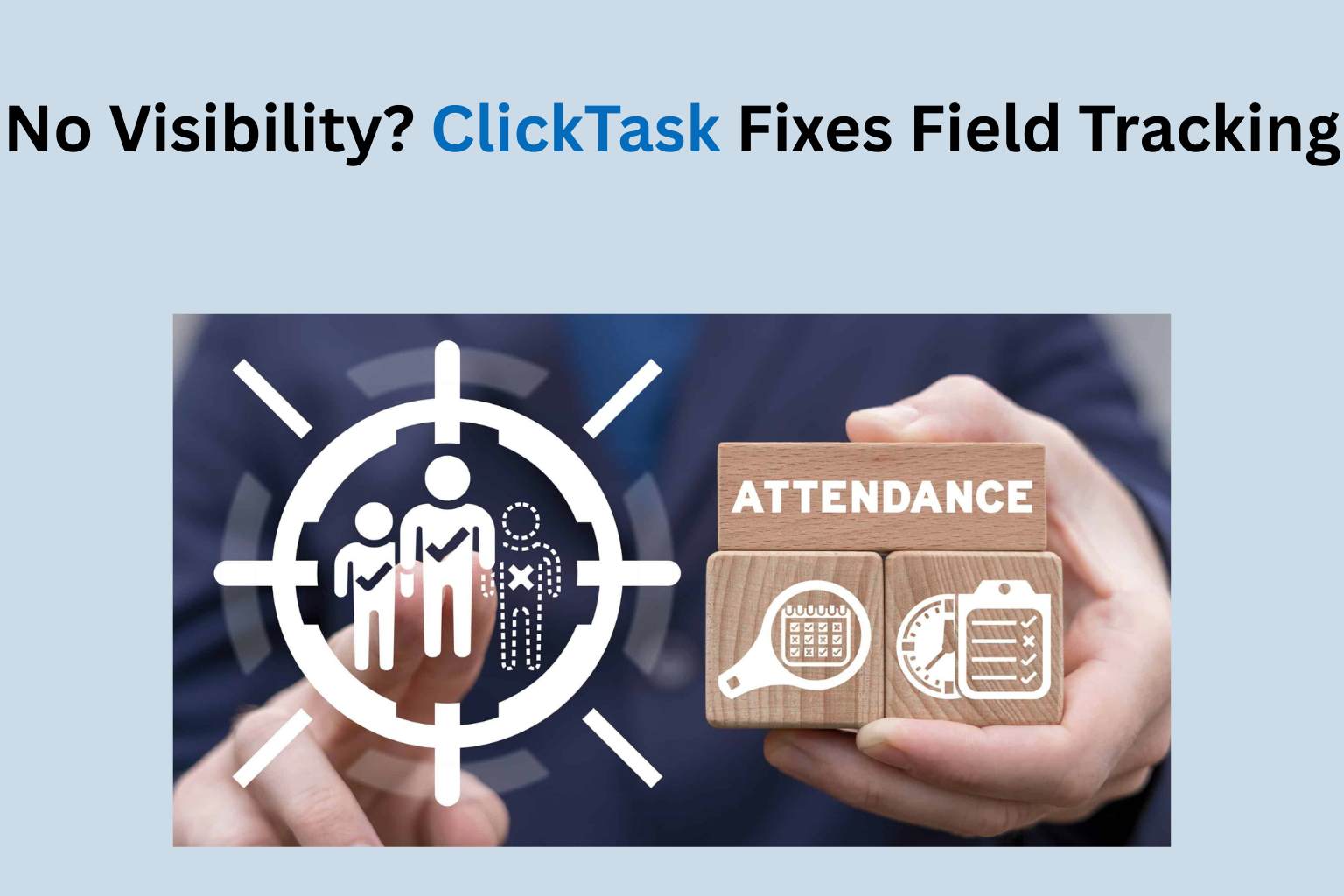
There is a particular kind of management frustration that does not have a name yet.
It is the feeling of running a field team of twenty-five people across three cities, knowing roughly what they are supposed to be doing, and having absolutely no reliable way to know what is actually happening right now. Not yesterday. Not in last week’s report. Right now, at 11:40 am on a Wednesday.
The problem is not that managers do not care. It is that the systems most Indian organisations use for employee attendance management were designed for a different kind of workforce – people who come to a building, sit at a desk, and leave at a fixed time. Apply those systems to a distributed field team and you get a gap. A large, expensive, largely invisible gap.
ClickTask by Aditi Tracking was built specifically to close that gap. Not by adding a feature to an existing HR tool. By rethinking what workforce visibility actually means when your team is never in the same place twice.
The problem with “modern” workforce tools that are not modern at all
The Indian enterprise software market has produced an impressive number of HRMS platforms in the last decade. Attendance modules, leave management, payroll integration, performance dashboards. Most large organisations have at least one of these running.
What they do not have, in most cases, is any live visibility into where their field employees are and what they are doing between clock-in and clock-out.
The attendance module records that Ramesh marked himself present at 9:02 am. What it cannot tell you is that Ramesh spent the next four hours in the same location he was in yesterday, covering territory that was assigned to someone else, while a priority account two kilometres away went unvisited for the third consecutive week.
That is not an attendance problem. That is a workforce deployment problem. And employee attendance management tools that only record presence – without capturing movement, location, and task completion – are solving the easier half of the question while leaving the harder half untouched.
What “real-time” actually means in this context
Real-time is a term that gets applied generously in software sales. A dashboard that refreshes every two hours is described as real-time. A report generated at end-of-day is described as providing real-time insights.
Real-time, in the context of a field team, means one thing: a manager opens their dashboard at any point during the working day and sees, accurately and immediately, where each person is. Not where they were at their last check-in. Not where they said they were going in the morning brief. Where they actually are, right now.
That capability changes what a manager can do. It is the difference between managing with information and managing with assumptions.
Four things that break without real-time visibility
Most organisations running field teams without live tracking do not realise what they are missing until they have it. Before that, the losses are experienced as vague inefficiencies – targets not quite hit, accounts not quite covered, expenses not quite adding up.
Here is where the gaps actually appear:
- Territory coverage drifts without detection – Field executives naturally gravitate toward familiar, comfortable accounts. Without location data, managers cannot see this drift until it shows up in sales numbers, which is typically one quarter too late.
- Idle time is invisible – A field executive who finishes three visits by noon and spends the afternoon at a chai shop is indistinguishable, in a report-based system, from one who worked straight through until 6 pm. End-of-day reports are written, not recorded.
- Incident accountability disappears – When a client claims a rep never visited, there is no clean way to verify or refute it. The manager is stuck between the client’s word and the executive’s word, with no data to break the tie.
- Expense claims become estimates – Mileage reimbursements submitted without GPS verification are essentially self-reported. Most of them are honest. Some of them are not. The organisation has no practical way to tell the difference.
Each of these problems is tolerable in isolation. Together, across a team of twenty or thirty field employees over a financial year, they represent a meaningful and entirely preventable cost.
What ClickTask brings to the table
ClickTask is Aditi Tracking’s field workforce management platform. It handles the full operational cycle for field teams – from attendance and location tracking to task assignment, visit verification, expense submission, and daily reporting – in a single system that runs on standard Android devices.
The distinction worth noting is that ClickTask was not designed as an employee attendance management tool that added a tracking feature. It was designed as a field operations platform where attendance is one input among several, and where the real value comes from the combination of data points that exist alongside it.
What the platform covers:
- Geo-tagged attendance at shift start – When a field executive marks attendance, their GPS coordinates are captured. The system records whether they were at the office, at a designated field location, or somewhere else entirely. There is no ambiguity about where they were when the day started.
- Continuous location tracking during work hours – Managers see a live map of their team throughout the day. The data is not dependent on the executive manually checking in. It runs in the background.
- Client visit logging with duration – When an executive reaches a designated client location, the visit is logged automatically. Time of arrival, time of departure, duration. The daily report is built from facts, not from memory.
- Task assignment and closure – Managers assign tasks to individual executives through the platform. The executive receives the task, confirms, completes, and closes it. Every step is timestamped.
- Expense submission with location context – Mileage claims and expense submissions are filed through the app, with GPS data attached. Reconciliation against actual travel records takes minutes.
- Daily report generation – At end of day, the executive submits their report through ClickTask. The platform already has the location data, visit records, and task completions. The report becomes an account of what happened, verified against what the system recorded.
The management quality shift that follows
There is a change in how field managers operate once they have live visibility into their teams. It is not dramatic. It does not announce itself. But it is consistent.
The first thing that shifts is the morning conversation. Instead of asking “what are you planning to do today,” managers start asking “based on yesterday’s coverage, here is what needs attention today.” The conversation moves from planning to directing, because the manager has the data to direct rather than trust.
The second shift is in how performance conversations happen. When there is an objective record of visits made, territory covered, and tasks completed, feedback becomes specific. “Your visit count was strong this week but three of your priority accounts had visits under ten minutes” is a different conversation from “I feel like you could be doing more.” One is manageable. The other is demoralising.
The third shift takes longer – usually a quarter or two. It shows up in coverage consistency. Territories that were being underserved get served, because the data makes the gap visible before it becomes a revenue problem.
Good employee attendance management is not just about knowing who showed up. It is about knowing what showing up actually produced.
Why the WhatsApp-and-Excel setup outlasts its usefulness
Most Indian organisations that have field teams know their current setup is not quite right. They have made peace with it because the alternative has felt like a large, uncertain project.
The honest answer is that it is not. ClickTask runs on the phones your field team already carries. The manager dashboard requires no specialist knowledge to read. Implementation does not require an IT project. And the data it produces in the first thirty days typically identifies enough inefficiency to cover the cost of the system.
The WhatsApp-and-Excel setup survives not because it works well, but because switching away from it has seemed harder than it is.
What ClickTask is and where it fits
Aditi Tracking has been building tracking infrastructure for Indian businesses since 2011. ClickTask is the product of that experience applied to field workforce management – a platform that treats employee attendance management not as an isolated HR function but as the foundation of operational intelligence for teams that work outside an office.
If your organisation is managing a field team and the most current data you have about what they are doing is last night’s report, that is the gap ClickTask closes.
Speak to the Aditi Tracking team. The demo takes thirty minutes. What it shows tends to prompt a fairly immediate conversation about what your current system is costing you.


 Smart Fleet
 Cool Bus
 Clicktask
 CommutePulse
 Wastetrail