
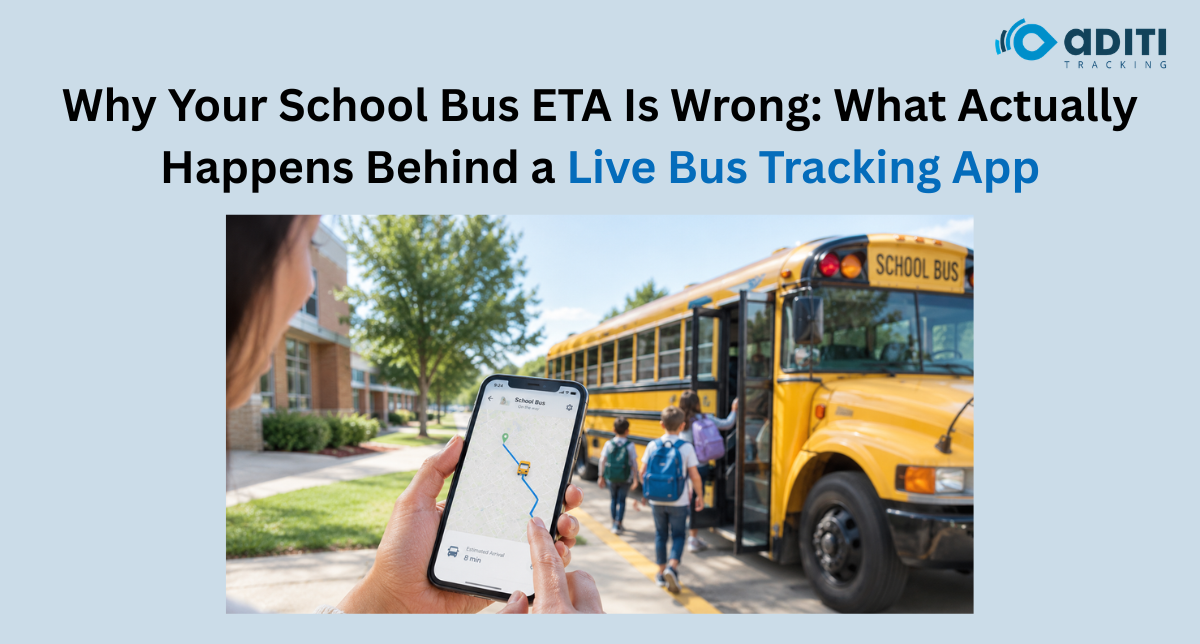
The school bus is shown as eight minutes away. A few minutes later, the ETA becomes twelve minutes. Then it suddenly drops to four.
For a parent waiting at a pickup or drop-off point, these changes can make a live bus tracking app feel unreliable. But an ETA is not simply a countdown clock attached to a moving bus. It is a continuously calculated estimate influenced by the vehicle’s location, route, traffic conditions, stoppages and the quality of the data reaching the tracking system.
Understanding what happens behind that ETA helps explain why some arrival predictions are more dependable than others.
A Bus Location and a Bus ETA Are Not the Same Thing
This distinction is easy to miss.
GPS can help determine where a school bus is currently located. ETA calculation attempts to answer a different question: when will that bus reach a particular stop?
Suppose a bus is 3 km from a student’s stop. Converting that distance into an arrival time requires the system to consider more than kilometres.
The bus may encounter:
- heavy traffic near a junction;
- an unexpectedly long student pickup;
- road construction or diversion;
- multiple scheduled stops before yours;
- slower movement around a school zone; or
- temporary GPS or mobile network issues.
A school bus tracking solution therefore needs to turn changing location information into something meaningful for parents and school administrators.
What Happens After the Bus Starts Moving?
A typical tracking process begins with a GPS-enabled device installed in the vehicle. As the school bus moves, location information is transmitted to the tracking platform.
The system can then use that information to represent the bus’s movement on a map and support arrival estimates.
In simple terms, the process looks like this:
Bus location → GPS data → network transmission → tracking platform → updated location and ETA
Each stage matters.
If fresh location data is delayed, for example, the system may temporarily calculate an estimate using information that no longer represents the bus’s exact current position.
That is why a live bus tracking app with accurate ETA depends heavily on the quality and continuity of the underlying data.
Why Does the ETA Keep Changing?
A changing ETA is not automatically a sign that the system is malfunctioning. Sometimes it means the estimate is responding to what is actually happening on the road.
Traffic can change within minutes
Morning and afternoon school runs frequently overlap with busy commuting periods in Indian cities. A route moving smoothly at one point can slow significantly at the next junction.
School buses make multiple stops
Unlike a vehicle travelling directly from point A to point B, a school bus follows a sequence of pickups or drop-offs.
One stop taking three minutes instead of one can affect the arrival estimates for several stops afterwards.
GPS data may not always update perfectly
Dense buildings, tunnels, network interruptions and other environmental conditions can occasionally affect the continuity of location information.
A live bus tracking app with real-time ETA for school buses must continually work with incoming location data as the journey progresses.
The route itself may change
Road closures, diversions or operational decisions can change the path a bus takes. An ETA based on the expected route may consequently need to be recalculated.
Why “Live” Does Not Mean Zero Delay
The word “live” can create an unrealistic expectation that the bus icon represents its physical position every millisecond.
In practice, tracking involves a chain of events. The device determines location, information is transmitted, the platform processes it and the school bus tracking app for parents displays the resulting update.
Even small delays at different stages can create a difference between the position shown on screen and the vehicle’s exact position at that instant.
What matters is whether updates are frequent and useful enough to give parents meaningful visibility into the journey.
What Makes an ETA More Useful?
A useful ETA requires more than placing a bus icon on a digital map.
The tracking system needs consistent location information and sufficient context around how the vehicle is moving.
For schools evaluating a school bus tracking solution, it is worth looking beyond the presence of GPS and asking how effectively the system supports day-to-day transport visibility.
Important considerations include:
- frequency and consistency of location updates;
- visibility of the bus’s current movement;
- route and stop information;
- notifications relevant to the journey;
- accessibility for parents and authorised school staff; and
- reliability during regular school transport operations.
A live bus tracking app with accurate ETA should ultimately reduce uncertainty, rather than simply provide more data.
Parents Need Context, Not Just a Moving Dot
Imagine a parent sees that the school bus has barely moved for five minutes.
Without additional context, they may wonder whether the app has stopped updating, the bus has broken down or there is simply heavy traffic.
This is why a school bus tracking app for parents is valuable when it helps turn vehicle movement into understandable journey information.
The purpose is not to encourage parents to watch a map throughout the entire trip. It is to help them make practical decisions about when to reach the stop and what to expect when the bus is delayed.
Better Tracking Starts With Better Visibility
No ETA can eliminate unpredictable traffic, extended stops or every disruption on Indian roads. What technology can do is make school transport movement more visible and help reduce the uncertainty surrounding daily pickup and drop-off.
Aditi Tracking offers school bus tracking capabilities that help schools and parents gain better visibility into vehicle movement. Its Cool Bus solution is designed around school transport tracking, helping educational institutions strengthen visibility across everyday bus operations.
Uncertainty around pickup and drop-off shouldn’t be part of every parent’s day. Book a Cool Bus demo for your school, or Download the Cool Bus catalogue to explore complete features and specifications.
FAQs
1. How does a live bus tracking app work?
A live bus tracking app uses location information from a GPS-enabled device in the vehicle and displays the bus’s movement through a connected tracking platform.
2. Why does my school bus ETA keep changing?
ETAs can change because of traffic, longer-than-expected stops, route conditions, diversions or changes in the latest location information available to the tracking system.
3. Can parents track the school bus in real time?
A school bus tracking system can provide parents with current vehicle location information through the interfaces and access provided by the particular solution.
4. How accurate is GPS school bus tracking?
GPS tracking can provide useful vehicle-location visibility, but accuracy and update consistency may be affected by factors such as GPS reception, network connectivity and the surrounding environment.
5. What should schools look for in a school bus tracking system?
Schools should consider location visibility, update consistency, route monitoring, relevant notifications, ease of use and the information available to parents and authorised administrators.


 Smart Fleet
 Cool Bus
 Clicktask
 CommutePulse
 Wastetrail