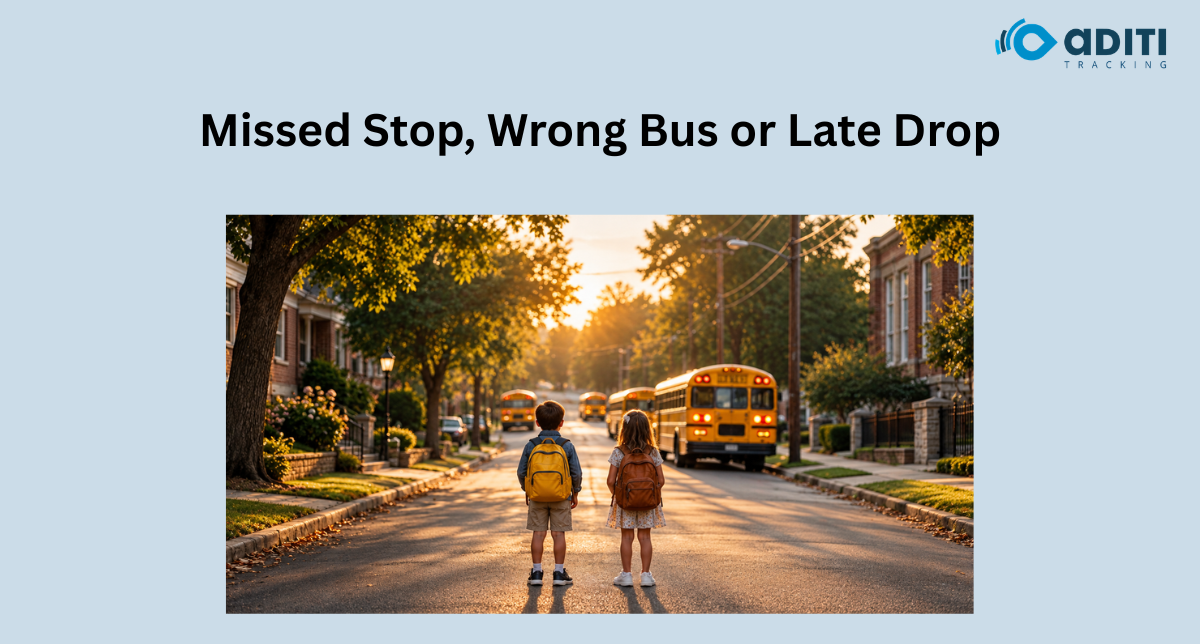
A parent calls the school and says the bus did not stop at the usual point. Another reports that a child reached home late. In such situations, guessing or making repeated calls is not enough. Effective school bus monitoring should give authorised teams enough information to understand the journey, while the ability to track bus location provides an important starting point.
The real challenge begins when someone asks, “What exactly happened?”
Start With a Typical 4:30 PM Complaint
Imagine a student was expected at the drop point around the usual time, but the bus arrived later than expected.
The parent wants an explanation.
The school transport coordinator calls the driver. The driver is still managing the route and remembers that there was a delay, but not the exact sequence of events.
This is where structured transport data becomes useful.
Instead of rebuilding the trip from memory, schools need to look at different parts of the journey and put them together.
First Check: Where Did the Bus Actually Travel?
Location history is the logical place to start.
When schools can track bus location, they have a clearer view of the vehicle’s movement rather than depending entirely on verbal accounts.
The transport team can examine questions such as:
- Which route did the bus follow?
- Where did it stop?
- Did it travel through the expected area?
- Was there an unusual route movement?
- When did it reach a particular location?
This does not automatically explain everything, but it establishes the physical journey.
If a parent reports a missed stop, for example, route information can help determine whether the bus reached the expected area.
Second Check: Was the Student Recorded on the Journey?
Knowing that a bus reached a stop still leaves another question.
Was the student actually on that bus?
This is why student attendance information adds an important layer to school bus monitoring.
Aditi Tracking’s CoolBus supports QR/RFID-based student attendance for check-in and check-out. This allows authorised users to connect student boarding or alighting information with the wider transport process.
Consider two different scenarios:
Scenario A: The bus reached the pickup point, but there is no expected student boarding record.
Scenario B: The student was recorded as boarding, but the parent later reports an issue with the drop.
These situations require different investigations. Vehicle location alone cannot clearly separate them.
Third Check: Did the Bus Follow the Expected Route?
A bus can be moving normally while still travelling somewhere it was not expected to go.
Route monitoring provides another piece of the picture.
CoolBus supports geofencing and route-deviation alerts, helping schools monitor whether buses operate along expected routes.
If a bus takes an unexpected path, the transport team has information that can help identify where the journey changed.
This matters because “the bus was late” is only an outcome.
The useful operational question is:
What happened during the route that contributed to the delay?
Fourth Check: What Information Was Sent During the Trip?
Parents should not have to continuously track bus location just to know whether the journey is progressing normally.
Alerts can make communication more practical.
CoolBus supports notifications relating to transport events such as departures, arrivals, route changes and school-zone activity.
When reviewing a complaint, this information can add another point of reference. The school can look at the journey together with the relevant transport updates instead of treating every phone call as an isolated issue.
This also helps reduce the information gap between the transport team and parents.
The Important Part Is Connecting the Data
No single data point tells the whole story.
GPS might show the route but not student attendance. Attendance may confirm that a child boarded but not explain an unusual route. An alert may identify a route change but needs the journey information around it.
Useful school bus monitoring comes from looking at these pieces together.
When investigating a transport issue, schools may need to review:
- Vehicle location and route movement
- Expected route and deviations
- Student check-in or check-out information
- Relevant journey notifications
- Trip timing and stops
Together, these provide a much stronger basis for understanding what happened than relying only on calls and memory.
What About the “Wrong Bus” Scenario?
This requires careful handling.
Technology should not encourage schools to assume that every reported issue can be explained instantly.
If a parent says a student boarded the wrong bus, the transport team should review the available student attendance and vehicle information before drawing conclusions.
The purpose of transport data is not to replace proper investigation. It is to give the school more reliable information to work with.
That distinction is important, especially when dealing with student transportation.
Build a Transport Record Before You Need It
Schools often discover gaps in their transport process only after a complaint occurs.
A better approach is to ensure that route, vehicle, attendance and notification information is being captured as part of normal daily operations.
Then, when something does go wrong, the school is not starting from zero.
Being able to track bus location is valuable, but combining location with attendance and route information creates a much clearer transport record.
Better Answers Start With Better Transport Visibility
When a parent reports a missed stop or late drop, the school needs facts rather than assumptions. Connecting bus location, route activity, student attendance and alerts can make transport incidents easier to review.
Aditi Tracking’s CoolBus brings live tracking, route monitoring, student attendance and journey notifications into one school transport solution. Schools looking for more structured visibility into daily bus operations can explore CoolBus according to their transport requirements.
Next time a parent calls, will you have answers or guesses?
Tell us how your school buses run today, and we’ll show you how CoolBus connects location, attendance, route and alert records.
Contact Us About CoolBus or Call Us
FAQs
1. What information is useful when investigating a late school bus?
Vehicle location, route movement, stops, route deviations and relevant journey information can help schools review why a trip was delayed.
2. Can schools track bus location in real time?
CoolBus provides live bus tracking, allowing authorised users to track bus location during school transport operations.
3. How does student attendance support school bus monitoring?
Attendance information helps schools understand student check-in and check-out activity alongside the vehicle journey.
4. Can CoolBus identify route deviations?
Yes. CoolBus supports route monitoring and geofencing features that can provide alerts when a vehicle moves outside expected route conditions.
5. Is GPS data alone enough to investigate every school transport issue?
Not always. Some situations may require location information to be reviewed alongside student attendance, route activity, alerts and other available transport records.


 Smart Fleet
 Cool Bus
 Clicktask
 CommutePulse
 Wastetrail