
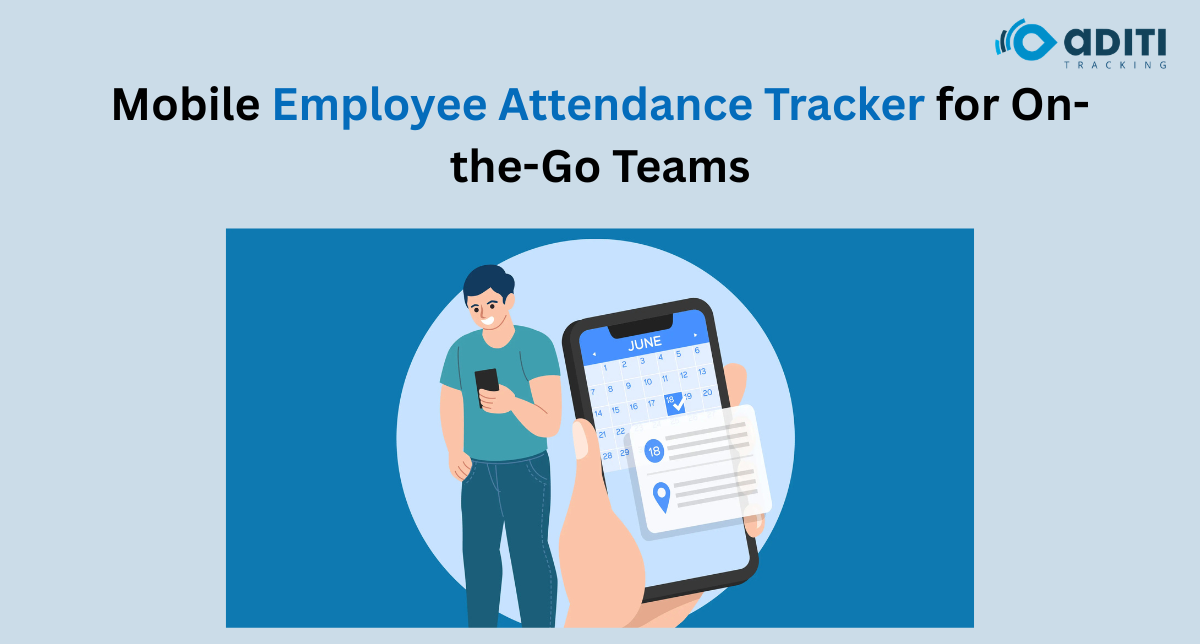
Ask any operations head running a distributed field team what their biggest administrative headache is, and attendance will come up within the first two minutes. Not payroll. Not performance reviews. Attendance – specifically, the daily scramble of figuring out who showed up, who did not, and whether the data anyone is looking at is actually accurate. The right employee attendance tracker does not just record presence. It removes the entire layer of uncertainty that manual systems leave behind.
The Office Attendance Model Does Not Translate To The Field
Biometric systems work well in offices. Everyone walks through the same door. The machine logs the time. Done.
Field operations do not have that luxury.
A sales executive starts her day at a client site in Andheri. Another begins at a distributor meeting in Thane. A service technician is already on-site at 7:30 AM in Navi Mumbai before the office even opens. None of them is walking through a central door. None of them can tap a biometric device.
So what happens instead? A WhatsApp message to the manager. A call to the coordinator. An entry in a shared Google Sheet that may or may not get filled by the end of the day. Three different people doing three different things, none of which produce consistent, verifiable data.
That inconsistency is exactly what a mobile employee attendance tracker is designed to solve.
What Mobile Attendance Actually Looks Like In Practice
The shift from manual to mobile tracking is less dramatic than most managers expect. The change is not in how many people show up – it is in how reliably that information gets captured and where it lives once it does.
With a mobile-first system, here is what changes operationally:
- Location-verified check-ins replace self-reported calls. The executive marks attendance from their phone, and the system records both the time and the GPS coordinates. No ambiguity about whether they were actually at the site.
- Automated attendance logs replace coordinator-maintained sheets. The data exists in the system from the moment the check-in happens, not after someone compiles it at the end of the week.
- Missed attendance flags automatically rather than being noticed during a manual review three days later. Managers see gaps in real time and can follow up immediately.
- Historical records are searchable without digging through folders or asking HR to pull a report. Attendance by employee, by date, by region – all of it accessible without a separate request.
These are not luxury features. They are the baseline for any organisation managing more than twenty field employees with any degree of accountability.
The Hidden Cost That Nobody Budgets For
Most companies budget for the tools they use. Very few budget for the work those tools create.
A manual employee attendance tracker – whether it is a spreadsheet, a WhatsApp group, or a paper register at a depot – generates a secondary workload. Someone has to collect the data. Someone has to clean it. Someone has to reconcile it against payroll. Someone has to handle the disputes when an employee says they were present and the record says otherwise.
That secondary workload sits on the desks of coordinators, HR executives, and operations managers who have other things to do. It is not invisible – people just stop noticing it because it happens every day.
The honest calculation is not just the cost of a mobile tracking system versus doing nothing. It is the cost of the system versus the full cost of maintaining the manual one, including the people hours it absorbs each week.
When that calculation gets done properly, the decision tends to become straightforward.
Why Mobile-First Matters Specifically For Indian Field Teams
India’s field workforce operates across conditions that a rigid, office-centric attendance system was never built for. Patchy connectivity in tier-2 and tier-3 cities. Teams are spread across large geographic areas with no fixed reporting point. Shift timings vary by client requirement rather than company policy.
A mobile employee attendance tracker that works offline, syncs when connectivity returns, and does not require a smartphone with high specifications is not a nice-to-have. It is a functional requirement for any Indian field operation trying to run at scale.
Clicktask Brings This To Your Field Team
Aditi Tracking’s ClickTask is built for the real operational conditions that Indian field teams work in. It gives managers live visibility into attendance, location, and task status without adding coordination overhead to anyone’s day. If your team is still tracking attendance manually, ClickTask is a practical, field-tested alternative worth evaluating.
FAQs
1. What is a mobile employee attendance tracker?
A mobile employee attendance tracker is a digital system that allows employees to mark attendance through their smartphones while recording time, location, and activity data in real time.
2. Why is mobile attendance tracking important for field employees?
Field employees often work across multiple locations without access to office biometric systems. Mobile attendance tracking helps businesses maintain accurate, location-verified attendance records without manual coordination.
3. How does GPS-based attendance tracking improve accuracy?
GPS-based attendance tracking verifies the employee’s location during check-in and check-out, reducing false reporting, proxy attendance, and manual errors in attendance records.
4. Can mobile attendance tracking work in low-network areas?
Yes. Many modern attendance tracking systems support offline functionality, allowing employees to record attendance without internet access and sync data automatically once connectivity returns.
5. What are the benefits of replacing manual attendance systems with mobile tracking?
Mobile attendance tracking reduces administrative workload, improves payroll accuracy, provides real-time visibility, automates reporting, and eliminates the inefficiencies of spreadsheets, calls, and paper-based records.



 Smart Fleet
 Cool Bus
 Clicktask
 CommutePulse
 Wastetrail