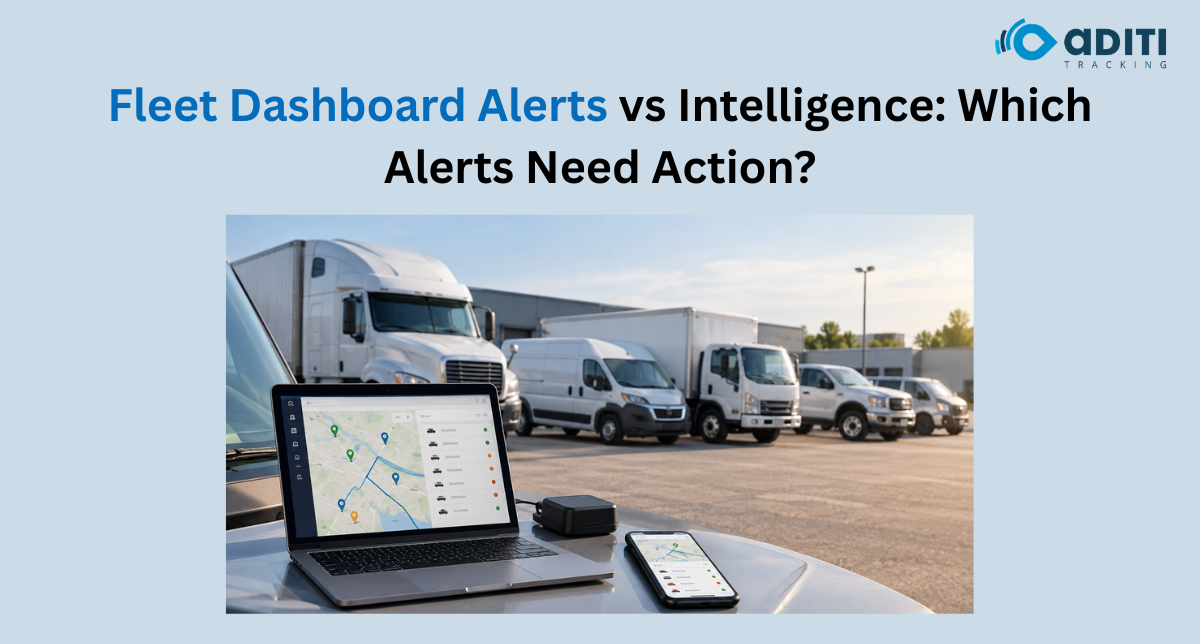
A fleet dashboard can generate an impressive amount of information. Speeding alerts, ignition events, geofence entries, route deviations, long stoppages and other notifications may arrive throughout the working day. But if a fleet manager receives 50 alerts and cannot immediately identify the three that require intervention, the system is creating noise rather than intelligence.
Effective tracking fleet management should help operators recognise exceptions that affect safety, security, cost or operations. The objective is not to maximise the number of alerts. It is to make important events difficult to miss.
More Alerts Can Actually Reduce Visibility
There is a natural assumption that more notifications mean greater control over a fleet.
In practice, excessive notifications can create alert fatigue.
See how Aditi Tracking prioritizes alerts by risk level.
When fleet managers repeatedly receive low-priority alerts, they may start dismissing notifications automatically. A genuinely important event can then appear among dozens of routine updates.
A gps fleet tracking solution should therefore support an operational question:
Does someone need to do something about this information now?
If the answer is consistently no, that event probably does not deserve the same prominence as a safety or security exception.
Start by Separating Information From Action
Not everything worth recording needs to trigger an immediate alert.
Consider ignition-on information. Knowing when vehicles start operating may be useful for historical reporting. But does a manager need a notification every time every vehicle starts?
For a fleet of 100 vehicles, probably not.
A practical alert strategy can separate events into three broad groups.
Immediate action
These are events where delaying a response could increase operational, safety or security risk.
Examples may include:
- unauthorised vehicle movement;
- significant route deviation;
- entry into or exit from a restricted geofence;
- unusual activity outside approved operating hours; or
- another predefined high-priority fleet exception.
Review soon
These events may not require an immediate phone call, but repeated occurrences could indicate a problem.
Examples include recurring speeding, excessive idling or unusually long stoppages.
Record for analysis
Some events are more valuable as data for reports and trends than as instant notifications.
This distinction makes tracking fleet management for real time vehicle tracking more manageable because the fleet team can focus attention according to urgency.
Which Alerts Deserve Immediate Attention?
There is no universal alert list for every business. A logistics fleet operating overnight has different priorities from a construction company moving equipment between sites.
Still, several categories frequently deserve closer attention.
Unauthorised vehicle movement
If a vehicle expected to remain parked begins moving outside approved hours, the fleet team may need to investigate quickly.
The important factor is context. Movement at 11 am may be routine. The same movement at 2 am may require attention.
Major route deviation
Minor deviations happen because of traffic, road closures or operational requirements. Constantly notifying managers about every small change creates noise.
A substantial or unexplained deviation from an assigned route is more actionable.
Repeated speeding
A single brief threshold crossing and a persistent speeding pattern are not necessarily equivalent.
A well-configured tracking fleet management system with live GPS tracking should help operators distinguish between routine data and behaviour that warrants review.
Geofence exceptions
Geofences become useful when they represent meaningful operational boundaries such as customer locations, depots, yards or restricted areas.
The mistake is creating so many geofence notifications that every ordinary journey generates multiple alerts.
Where Does Camera-Based Tracking Fit?
GPS can tell a fleet manager where a vehicle was and how it moved. In certain situations, visual information can provide additional context.
Still think more live-location visibility is the answer? Read our take on Why Real-Time Alerts Matter More Than Live Location Tracking — it explains why alerts, not raw tracking data, drive real fleet control.
This is where GPS fleet tracking with camera can support incident review.
Suppose a vehicle shows an unusual event on the tracking system. Location and movement data establish part of what happened, while relevant video information may provide additional context, depending on the system’s capabilities.
But cameras do not solve alert overload by themselves.
If GPS fleet tracking with a camera simply adds another stream of notifications without a defined review process, the fleet manager ends up with even more information to process.
Technology becomes useful when the organisation knows which events require attention and what should happen next.
Every Important Alert Needs an Owner
An alert without a response process is merely a notification.
For every high-priority alert, fleet operators should know:
- Who receives it?
- What should they verify?
- When should the driver be contacted?
- When should the issue be escalated?
- How should the event be recorded?
- Which recurring events require management review?
A gps fleet tracking solution becomes more operationally useful when alerts are connected to clear responsibilities.
For example, an unauthorised movement alert might require immediate verification, while repeated idling could be reviewed in a weekly operational report.
Both matter, but they should not demand the same response.
Not sure who should own which alert in your fleet?
Book a Free Demo with Aditi Tracking’s fleet experts — we’ll help you map alerts to the right response process.
Build Alerts Around Fleet Risk, Not Available Features
A common implementation mistake is enabling every notification simply because the platform provides it.
Instead, begin with actual fleet risks.
For tracking fleet management for real time vehicle tracking, ask what the organisation is trying to prevent or identify. Is the priority unauthorised vehicle use, route compliance, driver behaviour, excessive idling or vehicle security?
Once the business problem is clear, alerts can be configured around it.
This approach also makes a tracking fleet management system with live GPS tracking easier for operational teams to use because dashboards highlight exceptions rather than constantly demanding attention.
From Tracking Data to Actionable Fleet Visibility
Fleet intelligence is not measured by how many notifications appear on a dashboard. It is measured by whether the right information reaches the right person early enough to support a useful decision. Effective tracking fleet management therefore requires prioritisation, context and clear response processes.
Aditi Tracking provides GPS-based fleet tracking and monitoring solutions that help businesses improve visibility across vehicle operations. Fleet operators can explore Aditi Tracking’s solutions based on their tracking, monitoring and operational requirements.
FAQs
1. What are the most important GPS fleet tracking alerts?
The priority depends on fleet operations, but unauthorised movement, significant route deviations, important geofence events and recurring unsafe driving behaviour may warrant closer attention.
2. What is alert fatigue in fleet management?
Alert fatigue occurs when users receive so many notifications that they begin ignoring or automatically dismissing them, potentially causing important events to be overlooked.
3. How can fleet managers reduce unnecessary GPS alerts?
Managers can prioritise alerts according to operational risk, adjust relevant thresholds and move lower-priority information into periodic reporting rather than instant notifications.
4. What is the benefit of GPS fleet tracking with a camera?
GPS fleet tracking with camera can combine vehicle location information with relevant visual context, depending on the system’s capabilities, which can be useful when reviewing certain incidents.
5. Does real-time fleet tracking improve fleet management?
Real-time tracking can improve operational visibility by helping managers understand vehicle location and movement. Its practical value increases when tracking information is connected to meaningful alerts and defined response processes.


 Smart Fleet
 Cool Bus
 Clicktask
 CommutePulse
 Wastetrail