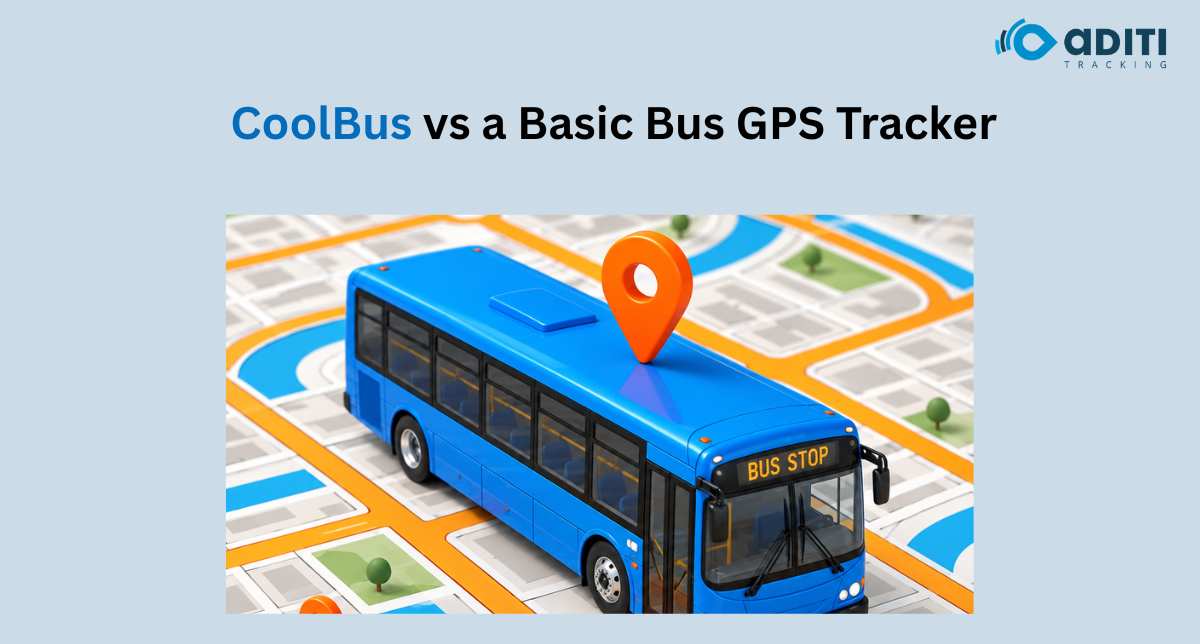
A basic bus GPS tracker can answer one important question: where is the school bus right now? But school transport involves more than vehicle location. Schools and parents may also need to know whether a child boarded the bus, whether the vehicle is following its assigned route, and whether there has been a delay or route change.
That is where a broader school transport management system becomes more useful than location tracking alone.
A School Bus Is Not Just Another Fleet Vehicle
School transport has a different set of responsibilities from a normal commercial fleet.
A logistics manager may mainly want to monitor a truck’s route, stops and delivery timing. A school transport team has to think about the bus, the driver, the route, the students and the parents waiting for information.
A typical morning can involve questions such as:
- Has the bus started its trip?
- Is it approaching the pickup point?
- Did the student board?
- Is the bus following its planned route?
- Is it delayed?
- Has the student reached school?
A basic tracker can answer only some of these questions.
What Does a Basic Bus GPS Tracker Usually Solve?
At its core, GPS tracking gives schools visibility into the vehicle.
With a bus GPS tracker, authorised users can monitor the location and movement of a bus rather than depending entirely on calls to drivers.
That alone can improve visibility. If a school has previously relied on manual updates, seeing the vehicle on a map can be a major step forward.
But consider this situation.
A bus reaches a student’s pickup location at 7:20 AM and then continues towards school. GPS confirms that the bus was there.
It does not necessarily answer whether that particular student boarded.
This is the point where vehicle tracking and student journey monitoring begin to separate.
Attendance Adds the Student to the Transport Picture
CoolBus extends monitoring beyond the bus itself through student attendance features.
Aditi Tracking’s CoolBus supports QR/RFID-based attendance for student check-in and check-out. This creates an additional layer of information around the journey.
Instead of only knowing:
“Bus 4 reached this location.”
The school transport process can also include information about student boarding and alighting.
That difference is important because parents are usually less concerned about the bus as a vehicle than they are about their child’s journey.
Attendance information can also reduce dependence on manual registers and repeated confirmation calls.
Alerts Reduce the Need to Keep Checking the Map
Live tracking is useful, but expecting parents or administrators to watch a moving bus icon continuously is not practical.
Most people need information only when something relevant happens.
CoolBus supports notifications for events such as departures, arrivals, route changes and school-zone entries. Parents can also receive updates relating to the school journey.
This changes the role of GPS.
Instead of opening the app every few minutes, users can receive relevant information as the trip progresses.
For a school managing multiple routes, that can also reduce unnecessary communication between parents, drivers and administrative staff.
Route Monitoring Answers More Than “Where Is the Bus?”
Suppose a school bus is visible through GPS, but it leaves its expected route.
A normal location view may show where the vehicle went. Route monitoring adds another question:
Was it supposed to go there?
CoolBus supports geofencing and route-deviation alerts, giving school transport teams greater visibility into whether vehicles are operating along expected routes.
This matters because route tracking is not just about watching movement. It is about comparing actual movement with planned movement.
A bus GPS tracker provides the location foundation, while route monitoring adds operational context to that location.
What Changes When These Features Work Together?
The real difference becomes clearer when attendance, alerts and route information are viewed as parts of the same school journey.
Imagine a normal morning trip:
- The bus begins its scheduled route.
- Parents can view its live location and estimated arrival.
- The bus reaches the assigned pickup point.
- Student attendance records the boarding activity.
- The vehicle continues along its planned route.
- Relevant notifications keep parents and school teams informed.
- Trip and route information remains available to authorised school users.
No single feature solves the entire transport challenge.
It is the connection between them that creates better visibility.
Schools Should Look Beyond the Moving Dot
A bus GPS tracker is useful, but schools choosing a transport system should first define what they actually need to monitor.
If the only requirement is knowing where buses are, basic GPS may be enough.
If the school also wants visibility around student attendance, route adherence, parent notifications and trip information, then a broader platform makes more operational sense.
The key questions should be:
- Who needs information?
- What information do they need?
- When do they need it?
- Which events should trigger an alert?
- How will student journeys be recorded?
This keeps the technology focused on the actual school transport process.
From Bus Tracking to School Transport Visibility
The biggest difference between basic GPS and CoolBus is the scope of information available. GPS focuses primarily on the vehicle. CoolBus brings together live tracking, route monitoring, alerts and student attendance features for school transportation.
Aditi Tracking’s CoolBus is designed for schools, transport managers and parents who need more than basic vehicle location. Schools looking to connect tracking with attendance and trip visibility can explore CoolBus based on their transport requirements.
Know more than where the bus is.
See how CoolBus connects live tracking, student attendance and parent alerts for safer school journeys.
FAQs
1. What is the difference between CoolBus and a basic bus GPS tracker?
A basic bus GPS tracker mainly provides vehicle location and movement visibility. CoolBus also includes features such as student attendance, route monitoring, notifications and dedicated apps for parents, drivers and managers.
2. Can CoolBus track student attendance?
Yes. CoolBus supports QR/RFID-based attendance for recording student check-in and check-out.
3. Can parents see where the school bus is?
Yes. CoolBus provides a parent app with live bus tracking, estimated arrival information and journey-related notifications.
4. Does CoolBus provide route-deviation alerts?
Yes. CoolBus includes geofencing and route monitoring features that can alert authorised users when a bus deviates from its expected route.
5. Does every school need a complete transport management system?
Not necessarily. Schools that only need vehicle location may find basic GPS sufficient. A broader system becomes more relevant when attendance, parent communication, route visibility and trip management also need to be connected.


 Smart Fleet
 Cool Bus
 Clicktask
 CommutePulse
 Wastetrail