
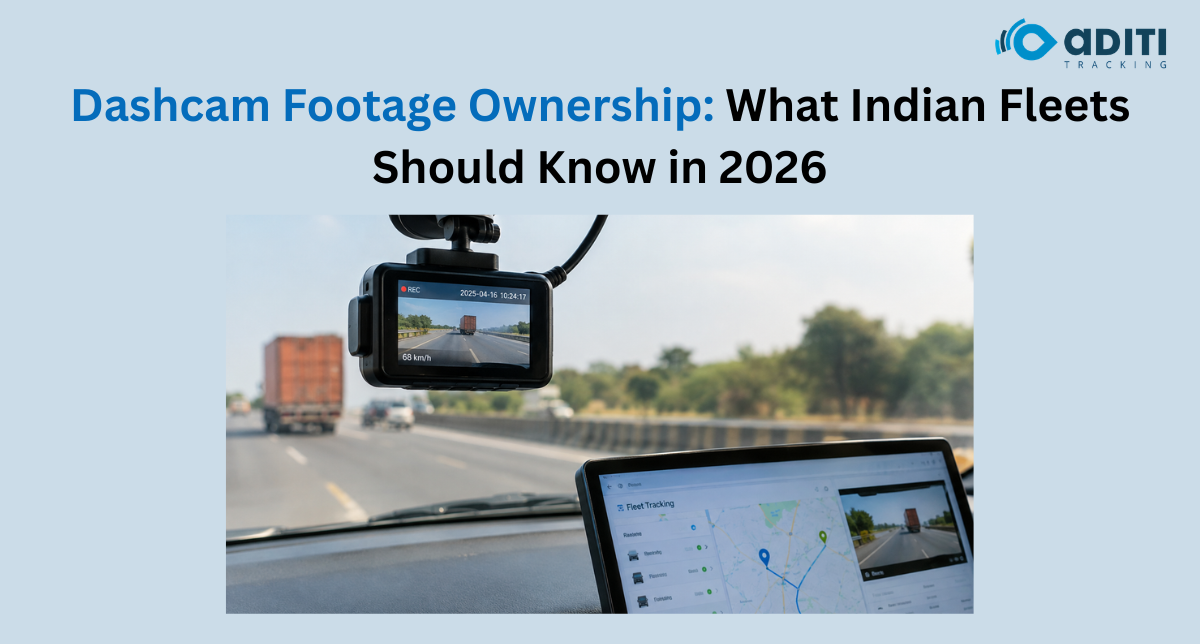
A fleet vehicle returns after an incident, and the dashcam has captured what happened. The obvious question is whether the footage can clarify the event. But another question is becoming just as important: who controls that recording, and who should be allowed to access it?
As Indian fleets increasingly combine a dash cam GPS tracker with telematics, video is becoming part of everyday fleet data. That creates practical responsibilities around collection, access, storage and employee privacy. In 2026, fleet operators should treat dashcam recordings as business data that requires proper governance, rather than as footage that can be viewed or shared casually.
Dashcam Footage Is More Than a Video File
Traditional fleet tracking largely answers questions about location and movement. Video adds another layer of information.
Depending on camera position and configuration, footage may capture the road, vehicle surroundings and potentially people. When a dash cam with gps tracking is involved, video may also be associated with location and journey information.
This makes the data useful for reviewing incidents, but it also makes responsible handling important.
For a fleet operator, the practical question is therefore broader than “Who owns the camera?”
It should be:
Who controls the footage, who can access it and why is it being retained?
Ownership and Access Are Not Necessarily the Same Thing
Fleet operators should avoid assuming that purchasing and installing a camera automatically answers every question about the resulting data.
There may be several parties involved in the information chain:
- the business operating the fleet;
- the employee driving the vehicle;
- people captured in the footage;
- the technology provider; and
- cloud or other infrastructure used for storing information.
The organisation may control how its fleet system is used, but access, processing and retention of recorded information still need to be handled according to applicable policies, contracts and Indian data protection requirements.
This is particularly relevant when dash cams, telematics and trackers bring video, location and vehicle activity into the same operational environment.
India’s Data Protection Environment Changes the Conversation
India’s Digital Personal Data Protection Act, 2023, and the Digital Personal Data Protection Rules, 2025 have made personal-data governance increasingly relevant for organisations using connected technologies.
Whether particular dashcam footage constitutes personal data depends on what is recorded and whether an identifiable individual is represented in that data.
That means fleet operators should not treat every recording as legally identical. They should determine what their cameras collect and obtain appropriate legal guidance where necessary.
Using a dash cam GPS tracker for real time vehicle tracking can potentially create a richer dataset than video alone because location and journey information may accompany the recording.
Before Installing Dashcams, Answer These Questions
The governance process should begin before cameras are deployed across dozens or hundreds of vehicles.
Fleet operators should establish:
- What is being recorded? Road-facing and cabin-facing cameras can raise different considerations.
- Why is it being recorded? Define legitimate operational purposes rather than collecting footage without a clear need.
- Who can view it? Access should be limited to authorised personnel.
- How long is footage retained? Keeping recordings indefinitely creates unnecessary data exposure.
- Where is the information stored? Operators should understand the storage arrangements associated with their system.
- When can footage be shared? There should be clear procedures for incidents, investigations and other authorised requirements.
These questions become even more important when a dash cam with GPS tracking connects video evidence with information about where and when a vehicle was operating.
Want detailed specifications on storage, retention capabilities and access-control features of our dashcam systems? Download the Dashcam catalogue for complete technical details.
Driver Monitoring Needs Clear Boundaries
Dashcams can support fleet visibility, but employers should not confuse operational monitoring with unrestricted surveillance.
Drivers should have reasonable clarity about what technology is installed in fleet vehicles, what information is collected and the business purpose behind it.
This becomes particularly important with cabin-facing cameras.
A dash cam GPS tracker used for legitimate fleet purposes should be supported by internal policies that define access and appropriate use. Managers should not be able to browse footage simply because the technology makes it possible.
Clear boundaries protect both employees and the organisation.
What Happens When Footage Is Needed After an Incident?
This is where good data practices become practical rather than theoretical.
Suppose a commercial vehicle is involved in a road incident. The fleet manager may need relevant footage to understand what occurred. If the organisation has already established access controls, retention practices and incident procedures, retrieving the appropriate information becomes more structured.
A dash cam GPS tracker for car security may also provide useful context when investigating incidents involving an organisation’s vehicles, depending on the capabilities of the deployed system.
However, footage should still be handled carefully. Copying a recording into informal messaging groups or unnecessarily circulating it internally can create risks that proper access controls were intended to prevent.
Video and Telematics Should Be Governed Together
Businesses often develop policies for vehicle tracking first and add cameras later. That can leave video data sitting outside the organisation’s existing governance processes.
A better approach is to consider dash cams, telematics and trackers as connected elements of fleet information management.
Policies can address:
- authorised access;
- purpose of monitoring;
- data retention;
- incident retrieval;
- sharing procedures; and
- employee awareness.
For fleets considering a dash cam GPS tracker for real time vehicle tracking, these governance questions should form part of implementation planning rather than being addressed only after an incident.
Make Video Visibility Responsible by Design
Dashcam technology can give fleet operators valuable context around vehicle journeys and road incidents. The value, however, depends on collecting and managing that information responsibly. A dash cam GPS tracker for car security or fleet monitoring should therefore sit within clear operational and data-handling practices.
Aditi Tracking provides dashcam and GPS-based fleet tracking solutions for businesses seeking greater visibility across their vehicle operations. Fleet operators can explore Aditi Tracking’s available solutions to identify an approach suited to their monitoring requirements.
Video data without proper governance is a liability waiting to surface — not a safeguard. Speak with Aditi Tracking today to build a dashcam and tracking setup that protects your fleet and your people.
FAQs
1. Who owns dashcam footage in a company vehicle in India?
There is no universal answer that applies to every situation. Control and rights relating to footage can depend on the organisation’s arrangements, contracts, purpose of recording and applicable Indian laws.
2. Can companies install dashcams in fleet vehicles?
Businesses can use dashcams for legitimate operational purposes, but should consider applicable privacy and data-protection requirements, particularly when identifiable individuals are recorded.
3. Can dashcam footage be combined with GPS information?
A dash cam GPS tracker can associate video-related information with vehicle location and journey data, depending on the capabilities and configuration of the system.
4. How long should fleet operators keep dashcam footage?
There is no single retention period appropriate for every fleet. Businesses should define retention according to their operational purpose, applicable legal requirements and internal data policies rather than keeping footage indefinitely without justification.
5. Is a dashcam useful for fleet security?
Dashcam footage can provide additional visual context when reviewing road events and vehicle-related incidents. When combined appropriately with GPS tracking, it can form part of a broader fleet monitoring approach.


 Smart Fleet
 Cool Bus
 Clicktask
 CommutePulse
 Wastetrail