
A GPS tracker that works perfectly on a desk may behave very differently after months on a commercial vehicle. Fleet hardware has to deal with vibration, weather exposure, irregular vehicle use, maintenance work and the simple reality that vehicles rarely operate under ideal conditions.
That makes the choice between a hardwired tracker and a magnetic gps tracking device more than an installation decision. The right option depends on what is being tracked, how continuously it needs to be monitored and how the equipment will actually be used in the field.
The Fundamental Difference Is Power and Installation
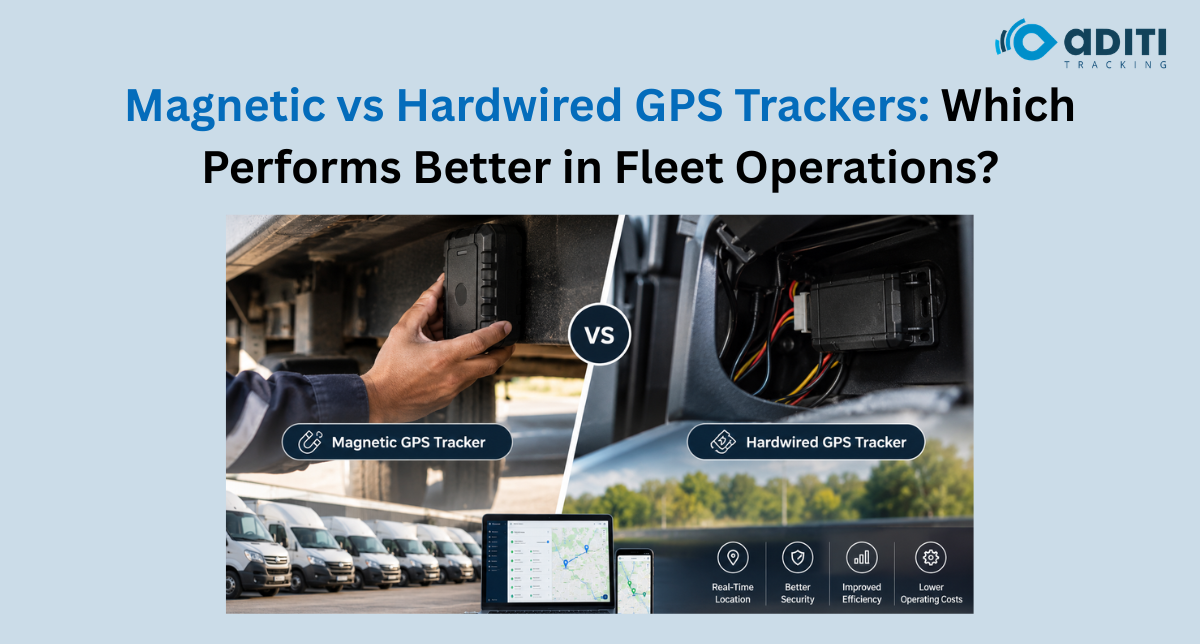
A hardwired GPS tracker is installed into the vehicle’s electrical system. Once properly installed, it can support ongoing tracking without someone routinely removing the device for charging.
A magnetic tracker takes a different approach. It can be attached to a suitable metal surface without permanent wiring and generally operates using its own battery.
That flexibility can be useful for assets or situations where permanent installation is impractical.
But flexibility introduces another responsibility: battery management.
For fleet operators, neither design is automatically better. Each solves a different operational problem.
Where a Magnetic Tracker Has the Advantage
The obvious benefit of a magnetic gps tracking device is deployment flexibility.
Suppose a business needs visibility over equipment that moves between sites but does not have a convenient permanent power source. Installing and wiring a conventional vehicle tracker may not be practical.
A magnetic unit can potentially provide a simpler tracking approach for suitable assets.
This can make it relevant when businesses need:
- non-permanent installation;
- tracking for movable assets or equipment;
- quick deployment;
- flexibility to move the tracker when operational needs change; or
- location visibility without modifying the asset’s electrical system.
A magnetic GPS tracking device for vehicle security can also provide an additional tracking option where the particular operational requirement suits a portable, battery-powered device.
The Biggest Weakness Is Easy to Predict: The Battery
The independence of a battery-powered tracker is also its limitation.
A hardwired tracker draws power through its installed vehicle connection. A magnetic tracker cannot operate indefinitely without battery management.
This creates an operational question that businesses sometimes overlook:
Who is responsible for making sure the tracker remains charged?
If nobody owns that responsibility, a portable tracker can eventually become an expensive object attached to an asset but providing no current location information.
A magnetic GPS tracking device with live location tracking therefore needs to be evaluated not only for its tracking capability but also for how its power requirements fit the intended use.
What Does Magnetic Motion Tracking Actually Add?
Battery-powered trackers need to use available power sensibly.
Magnetic motion tracking can be relevant because movement can help determine when an asset requires active tracking behaviour, depending on the device and its configuration.
For example, an asset that remains stationary for extended periods does not necessarily create the same tracking requirement as a commercial vehicle travelling throughout the day.
This distinction matters for equipment, trailers and other movable assets where movement may be intermittent.
However, fleet operators should avoid assuming that magnetic motion tracking removes the need for battery monitoring. Power still remains a finite resource.
Hardwired Trackers Are Built Around Continuity
For vehicles operating every day, a hardwired tracker has a practical advantage: continuity.
Once professionally installed and maintained, the tracking device can remain connected to the vehicle rather than depending on somebody remembering to recharge and reinstall it.
That can make hardwired tracking more appropriate for:
- commercial vehicles operating daily;
- buses;
- logistics fleets;
- employee transportation vehicles;
- vehicles requiring continuous fleet visibility; and
- operations where regular tracker charging would be impractical.
There are trade-offs. Installation requires access to the vehicle’s electrical system, and wiring can potentially be affected during maintenance or electrical work.
The decision therefore depends on which operational inconvenience the fleet can manage more effectively.
What About the Magnetic Tracking Sensor?
The term magnetic tracking sensor can be misleading if it creates the impression that the magnet itself performs the GPS tracking.
The magnet primarily provides a practical mounting method. Location tracking still depends on the GPS tracking technology within the device, along with the communication needed to transmit relevant information.
For operators comparing devices, the important considerations are therefore broader than magnetic strength alone.
They should consider:
- battery capacity and charging requirements;
- GPS and communication capability;
- intended installation environment;
- frequency of location updates;
- expected movement of the asset; and
- how securely the device can be positioned.
A magnetic tracking sensor or magnetic mounting arrangement should be considered as part of the overall tracking design rather than the entire solution.
Which One Handles Real Fleet Operations Better?
There is no universal winner.
For a truck travelling hundreds of kilometres every day, a properly installed hardwired tracker may make more operational sense because continuous power is important.
For a movable asset that cannot easily support permanent wiring, a magnetic gps tracking device may provide greater deployment flexibility.
A useful way to make the decision is to ask four questions:
- Does the asset have a reliable power source?
- How frequently does it move?
- How continuously must its location be available?
- Can the business realistically manage battery charging?
If continuous tracking is critical and vehicle power is available, hardwiring may be the practical choice. If installation flexibility matters more, magnetic tracking deserves consideration.
Security Requirements Change the Decision
A magnetic GPS tracking device for vehicle security should also be evaluated based on how and where the device will be deployed. Physical placement, battery availability and the organisation’s monitoring process all influence its usefulness.
Similarly, choosing a magnetic GPS tracking device with live location tracking should involve understanding expected update behaviour and how quickly battery capacity may be consumed under the intended tracking pattern.
The hardware has to match the operational reality.
Choose the Tracker Around the Asset
Fleet tracking works better when hardware is selected around how a vehicle or asset actually operates, rather than applying one device type everywhere. Hardwired tracking prioritises continuity, while magnetic tracking prioritises installation flexibility and portability.
Aditi Tracking provides GPS tracking solutions including wireless and magnetic asset trackers for different vehicle and asset-monitoring requirements. Businesses can explore Aditi Tracking’s available tracking options to determine which approach better fits their operations.
Fleet operations don’t wait for the “right” decision — every idle asset costs you time and money. Talk to Aditi Tracking’s team today and get a customized recommendation matched to your fleet’s real operational needs.
FAQs
1. What is a magnetic GPS tracking device?
A magnetic gps tracking device is a portable GPS tracker designed to attach to a suitable metal surface using a magnetic mounting arrangement, typically without permanent vehicle wiring.
2. Does a magnetic GPS tracker need charging?
Battery-powered magnetic GPS trackers require charging or battery management. The actual frequency depends on the device, configuration and usage pattern.
3. Is a hardwired GPS tracker better for commercial fleets?
Hardwired tracking can be more suitable for vehicles that operate regularly and require ongoing tracking because the device can draw power from the vehicle’s electrical system.
4. Can magnetic GPS trackers provide live location information?
Compatible magnetic GPS trackers can transmit location updates, but update frequency and operating duration depend on the specific device, connectivity, configuration and available battery power.
5. What should businesses consider before choosing a magnetic tracker?
Businesses should consider the asset type, installation environment, battery requirements, desired location-update frequency, connectivity and whether a portable tracker suits the operational use case.



 Smart Fleet
 Cool Bus
 Clicktask
 CommutePulse
 Wastetrail