
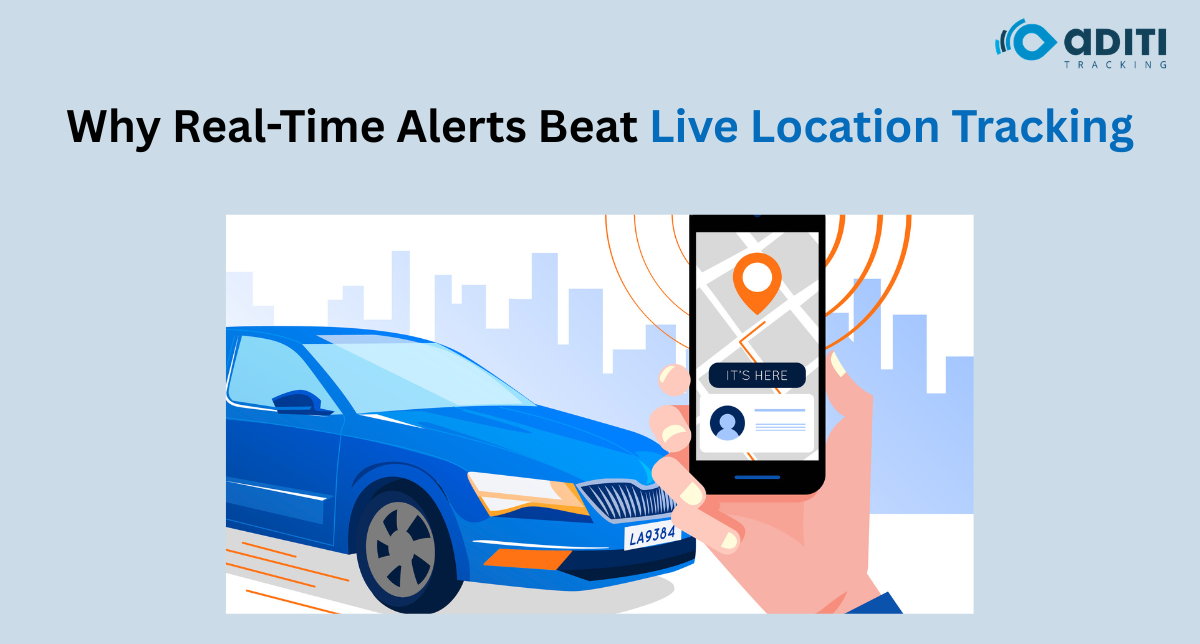
Everyone wants a live location. It is the feature that sells the product, shows up first in every demo, and gets the most airtime in vendor presentations. You open an app, you see your vehicles moving on a map, and it feels like control.
It is not controlled. It is a view.
A car tracking device in India that shows you live location is telling you where your vehicle is right now. That is useful, in the same way that a CCTV feed of your warehouse is useful. But a CCTV feed does not call you when something goes wrong. It just records. You have to be watching, at the right moment, to catch anything.
Real-time alerts are different. They do not wait for you to look. They come to you the moment something needs your attention. And that difference, between passive visibility and active notification, is where most of the operational value actually lives.
The Problem With Live Location As A Primary Tool
Live tracking requires someone to be watching. Actively, continuously, with enough context to recognise when something on the map looks wrong.
In practice, this rarely happens. An operations manager overseeing 25 vehicles cannot stare at a map for eight hours a day. Drivers know this. Vehicles drift off route for ten minutes and drift back. A truck idles outside a dhaba for 40 minutes at a point when nobody is watching the dashboard. A vehicle enters a restricted zone and exits before anyone notices.
The events happened. The data is there. But because nobody was watching at the right moment, the visibility produced no action.
This is the fundamental limitation of live tracking as a control mechanism. It is reactive by design. You see what is happening only when you are looking. And in a fleet operation, you cannot always be looking.
What Real-Time Alerts Actually Do
An alert does not require attention. It demands it.
When a car tracking device in India is configured to send an alert the moment a vehicle exceeds a set speed threshold, the operations manager does not need to be watching the map. The notification arrives on their phone. The event is logged with a timestamp and location.
A follow-up action, a call to the driver, a note on the record, a coaching conversation, becomes possible because the event surfaced immediately, not discovered three days later during a report review.
This is the core difference. Live tracking surfaces information passively. Alerts surface information actively, at the moment when acting on it still makes a difference.
A speeding alert sent at the moment of the event lets you call the driver while he is still on that stretch of road. The same data discovered in a weekly report is a historical fact with no corrective value.
The Alerts That Produce The Most Operational Impact
Not all alerts are equally useful. Some generate noise. Others change outcomes. Here is where the real value sits.
Geofence Breach Alerts
A vehicle leaving a defined zone or entering a restricted one is an event with immediate implications. For goods transport, a geofence breach on a designated route means unauthorised deviation. For school buses, it means the bus is somewhere it should not be. For corporate cab operations, it flags a driver taking a different path than the assigned one.
The alert arrives in seconds. The response window is open. Without the alert, the breach is a data point in a trip history that someone reads on Friday afternoon.
Panic Button Alerts
For passenger vehicles, school buses, and late-night corporate transport, the panic button is the most time-sensitive alert the system can generate. A driver in distress has seconds to act. An alert that reaches a control room or fleet manager within 30 seconds of the button being pressed is a meaningful safety mechanism. The same event discovered the next morning is not.
Ignition-Off Alerts In Unexpected Locations
A vehicle that shuts off its engine in an unscheduled location, a side road, an unregistered stop, a location that does not match any planned waypoint, is one of the most telling signals a fleet can generate. It could be a breakdown. It could be an unauthorized goods transfer. It could be a driver stopping to siphon fuel. The alert does not tell you which one. It tells you to find out, right now, while the window to act is still open.
Harsh Driving Event Alerts
A single harsh braking event is not a crisis. A driver who triggers five harsh braking events in one trip has a driving pattern that needs addressing. Alerts configured around driving behaviour create a feedback loop that weekly reports simply cannot replicate. The driver knows the event was logged. The manager knows it was logged. The conversation that follows is grounded in a specific, timestamped incident rather than a general instruction to “drive more carefully.”
Why Most Fleets Underuse Alerts
Two reasons. Configuration and follow-through.
Default alert settings in most car tracking device in India platforms are built for a generic fleet. Speed thresholds that are either too low or too high for your specific routes. Geofences that cover too broad an area to be meaningful. Idle alerts that fire so frequently they become background noise within a week.
Alert fatigue is real. When alerts arrive too often, people stop reading them. When alerts are ignored, the system has failed, not because it is generating wrong data, but because the signal got buried under irrelevant noise.
Configuration is not a one-time setup task. It is an ongoing calibration. Tighten thresholds that produce too many alerts. Expand ones that miss genuine events. Assign alerts to the right people; not every alert needs to reach every manager. Route breach alerts belong with the operations team. Panic button alerts belong with a dedicated responder.
The second reason alerts go unused is that nobody closes the loop. An alert that arrives and gets acknowledged without a follow-up action trains the team to treat alerts as FYIs rather than action triggers. Build a simple protocol: who receives which alert, what they do with it, and how the resolution is logged. Without that structure, even a perfectly configured alert system produces awareness without accountability.
Live Location Still Has Its Place
None of this means live tracking is useless. It is genuinely valuable for real-time customer communication, for dispatch decisions when a new job comes in and you need to assign the nearest available vehicle, and for investigations after an incident when you want to reconstruct a timeline.
The point is not that the live location is wrong. The point is that it is overweighted in how most fleets think about their tracking investment. Alerts are the mechanism that makes tracking proactive. Live location is the mechanism that makes it visible.
You need both. But if you are only optimising one of them, optimise the alerts.
Build A Fleet That Responds In Real Time
Knowing where a vehicle is has value. Knowing the moment something changes and having the ability to act immediately is what improves fleet performance. A well-configured alert system helps businesses respond faster to safety incidents, route deviations, excessive idling, fuel anomalies, and driver behaviour before these events become larger operational or financial problems.
At Aditi Tracking, we help organisations move beyond basic vehicle tracking with an intelligent fleet management platform that combines real-time alerts, GPS tracking, fuel monitoring, driver behaviour analytics, geofencing, and telematics into a single operational ecosystem. Every alert can be configured around your fleet’s workflows, ensuring the right information reaches the right people at the right time without creating unnecessary notification overload.
If your current tracking system only shows vehicle locations but does little to help your team respond proactively, connect with Aditi Tracking to discover how an intelligent, alert-driven fleet management solution can help your business stay one step ahead.
FAQs
1. Why are real-time alerts important in a car tracking device in India?
Real-time alerts notify fleet managers immediately when specific events occur, such as speeding, route deviations, excessive idling, or geofence breaches. Unlike live location tracking, alerts enable quick action, helping improve safety, efficiency, and operational control.
2. How are real-time alerts different from live location tracking?
Live location tracking shows where a vehicle is at a given moment, while real-time alerts automatically notify users when predefined events happen. This proactive approach helps businesses respond faster without constantly monitoring a tracking dashboard.
3. Which real-time alerts should fleet operators enable?
The most valuable alerts typically include overspeeding, geofence entry and exit, panic button activation, ignition on/off, prolonged idling, route deviation, harsh driving events, and fuel-related alerts. The ideal combination depends on your fleet’s operational requirements.
4. Can too many alerts reduce the effectiveness of a tracking system?
Yes. Excessive or poorly configured alerts can lead to alert fatigue, causing important notifications to be overlooked. Configuring relevant thresholds and assigning alerts to the appropriate team members helps ensure the system remains useful and actionable.
5. Can a car tracking device in India improve fleet safety through alerts?
Yes. A properly configured car tracking device in India can enhance fleet safety by providing immediate notifications about unsafe driving behaviour, emergency situations, and route deviations. This allows fleet managers to respond quickly and take corrective action before issues escalate.


 Smart Fleet
 Cool Bus
 Clicktask
 CommutePulse
 Wastetrail