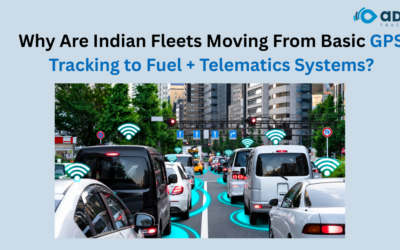
The question comes up in almost every fleet evaluation conversation. You have a budget. You have a problem to solve. And you are trying to decide whether a basic GPS tracking setup covers what you need or whether you are better off with a full telematics system that costs more and does considerably more.
Both options have genuine merit. The wrong choice is not about picking the inferior technology. It is about picking the right technology for the wrong context, and paying the price for the mismatch every month for the next three years.
Choosing a GPS tracking company in India that offers both options and asks the right questions about your operations before recommending one is the clearest sign you are talking to the right vendor. The ones who push the more expensive option immediately, or the cheaper one without asking, are not thinking about your ROI. They are thinking about their margin.
Here is how to think about this decision properly.
What GPS Tracking Actually Is And Is Not?
A basic GPS tracking setup does one thing well: it tells you where your vehicles are and where they have been. Real-time location, trip history, geofencing, ignition events, and basic alerts. That is the core capability and for many fleet operations it is genuinely sufficient.
A school transport operator who needs to show parents live bus location. A small contractor running four vehicles who wants to confirm drivers are where they say they are. A retail delivery business that needs to give customers accurate ETAs. For all of these, a well-configured GPS device from a reliable GPS tracking company in India solves the problem without overcomplicating the setup.
The limitation is not that GPS tracking is weak. It is that location data alone cannot explain behaviour. It tells you the vehicle was stationary for two hours. It does not tell you why. It tells you the vehicle covered 600 kilometres. It does not tell you what that cost relative to what it should have.
When the unanswered questions start costing money, that is when telematics enters the conversation.
What Smart Telematics Adds To The Picture?
Telematics is GPS plus a layer of vehicle and driver data that location alone cannot capture. Depending on the system, it includes:
- Engine diagnostics pulled directly from the vehicle’s OBD port
- Fuel consumption measured in real time via sensor, not estimated from distance
- Driver behaviour scoring based on accelerometer and gyroscope data
- Temperature monitoring for cold chain vehicles
- Predictive maintenance alerts based on engine hours and fault codes
- Integration with dashcams for incident recording
The difference in data depth is significant. A telematics system does not just tell you the vehicle covered 600 kilometres. It tells you the fuel burn per kilometre, the number of harsh braking events, the engine idle time, whether the vehicle threw a fault code three days before the breakdown, and how the driver’s behaviour this week compares to last month.
That is a different category of operational insight.
The Roi Question: Where The Numbers Actually Sit
ROI on fleet technology is not a theoretical calculation. It is a function of what you are losing right now and how much of that the technology recovers.
Where basic GPS tracking delivers clear ROI
- Unauthorised vehicle use after hours – easily caught, quickly stopped
- Disputed delivery timelines – location data resolves client disputes without arguments
- Basic route adherence – confirms drivers are following assigned routes
- Reduced need for check-in calls – operations team gets back productive time
For a fleet where these are the primary problems, basic GPS from a solid GPS tracking company in India returns its investment within three to four months. The setup cost is lower, the monthly subscription is lower, and the problem being solved is well-defined.
Where telematics delivers ROI that GPS cannot match
- Fuel leakage and theft – sensor-level data, not estimates
- Predictive maintenance – catching faults before breakdown, not after
- Insurance premium reduction – documented driver behaviour data supports lower risk classification with some insurers
- Driver performance improvement – scored behaviour data changes habits more durably than verbal instruction
- Cold chain compliance – temperature logs for pharmaceutical and food logistics that customers increasingly require
The ROI here is larger in absolute numbers but takes longer to fully materialise. Fuel savings are immediate. Maintenance savings compound over 12 to 18 months. Insurance benefits require documented history. Fleet operators who evaluate telematics ROI at the three-month mark often underestimate it. The ones who measure at 18 months see the full picture.
The Fleet Size Question Matters More Than Most Buyers Realise
For a five-vehicle fleet, the operational overhead of managing a full telematics system – reviewing driver scores, acting on engine fault alerts, calibrating fuel sensors – may not be proportionate to the benefit. One person running five vehicles probably does not need a maintenance prediction engine. They need to know where their vehicles are and whether drivers are doing their jobs.
For a 50-vehicle fleet, the calculus shifts entirely. The operational complexity of managing 50 vehicles without behaviour data, fuel monitoring, and maintenance alerts creates a management burden that grows faster than the fleet does. At that scale, the telematics system is not an upgrade. It is an operational necessity.
The honest version of this conversation: most fleets under 15 vehicles are well-served by GPS tracking. Most fleets over 30 vehicles are leaving money on the table without telematics. The 15 to 30 range depends heavily on the industry, the route type, and how tightly margins are being managed.
What Does The Right Vendor Conversation Look Like?
A GPS tracking company in India worth working with does not open the conversation with a product recommendation. It opens with questions.
What industry are you in? What size is your fleet? What are your biggest operational pain points right now? Have you had fuel theft issues? How do you currently handle maintenance scheduling? Do you have compliance requirements from clients or regulators?
The answers to these questions determine whether GPS or telematics is the right starting point – and whether a phased approach makes more sense than either. Some fleets are better served by starting with GPS tracking for three months, establishing a baseline, and then adding fuel monitoring and behaviour scoring once the team knows how to use tracking data.
Phasing is not a consolation prize. It is sometimes the smarter path to full ROI.
The One Question That Settles Most Of These Comparisons
What decision will you make differently if you have this data?
If the answer is concrete and operational – you will change routes, coach specific drivers, reconcile fuel bills differently, schedule maintenance earlier – the technology pays for itself. If the answer is vague – you just want visibility, you want to know what is happening – the cheaper option is almost always sufficient.
Technology does not improve operations. Decisions made from technology do. The ROI on any fleet tracking system, GPS or telematics, is a direct function of how seriously the organisation uses the data it generates.
That is the variable that no vendor can control for you.
Choose The System That Solves The Right Fleet Problem
The better ROI does not automatically come from the more advanced system. It comes from choosing technology that matches your fleet size, operating risks, reporting needs, and ability to act on the data.
Aditi Tracking helps businesses make that decision with a practical, operations-first approach. From real-time GPS tracking and route visibility to fuel monitoring, driver behaviour insights, video telematics, and advanced fleet analytics, we offer scalable solutions that can grow with your operational requirements.
Our team can assess where your fleet is currently losing time, fuel, visibility, or control and recommend the features that are likely to deliver measurable value. That may mean starting with dependable GPS tracking, adopting a complete telematics platform, or introducing advanced capabilities in phases as your fleet expands.
Schedule a consultation with Aditi Tracking to identify the right fleet tracking solution that reduces losses, improves efficiency, and maximizes your return on investment.
FAQs
1. What is the difference between GPS tracking and smart telematics?
GPS tracking primarily provides real-time vehicle location, trip history, and route monitoring. Smart telematics builds on these features by adding vehicle diagnostics, fuel monitoring, driver behaviour analysis, maintenance alerts, and other operational insights for more comprehensive fleet management.
2. Which businesses should choose GPS tracking over smart telematics?
Businesses with smaller fleets or basic tracking needs, such as monitoring vehicle location and improving route visibility, often find GPS tracking sufficient. Companies with larger fleets or more complex operations may benefit more from the additional capabilities offered by smart telematics.
3. How do I choose the right GPS tracking company in India?
A reliable GPS tracking company in India should understand your fleet size, operational challenges, and business goals before recommending a solution. Look for providers that offer certified devices, dependable technical support, scalable platforms, and solutions tailored to your specific requirements.
4. Does smart telematics provide a better return on investment than GPS tracking?
It depends on your fleet’s needs. GPS tracking often delivers a faster return for businesses focused on vehicle visibility and route management, while smart telematics can generate greater long-term savings through improved fuel efficiency, predictive maintenance, and driver performance management.
5. Can I upgrade from GPS tracking to smart telematics later?
Yes. Many fleet operators begin with GPS tracking and expand to smart telematics as their operations grow. A scalable solution allows businesses to add advanced features such as fuel monitoring, vehicle diagnostics, and driver behaviour analytics without replacing the entire tracking system.

 Smart Fleet
 Cool Bus
 Clicktask
 CommutePulse
 Wastetrail