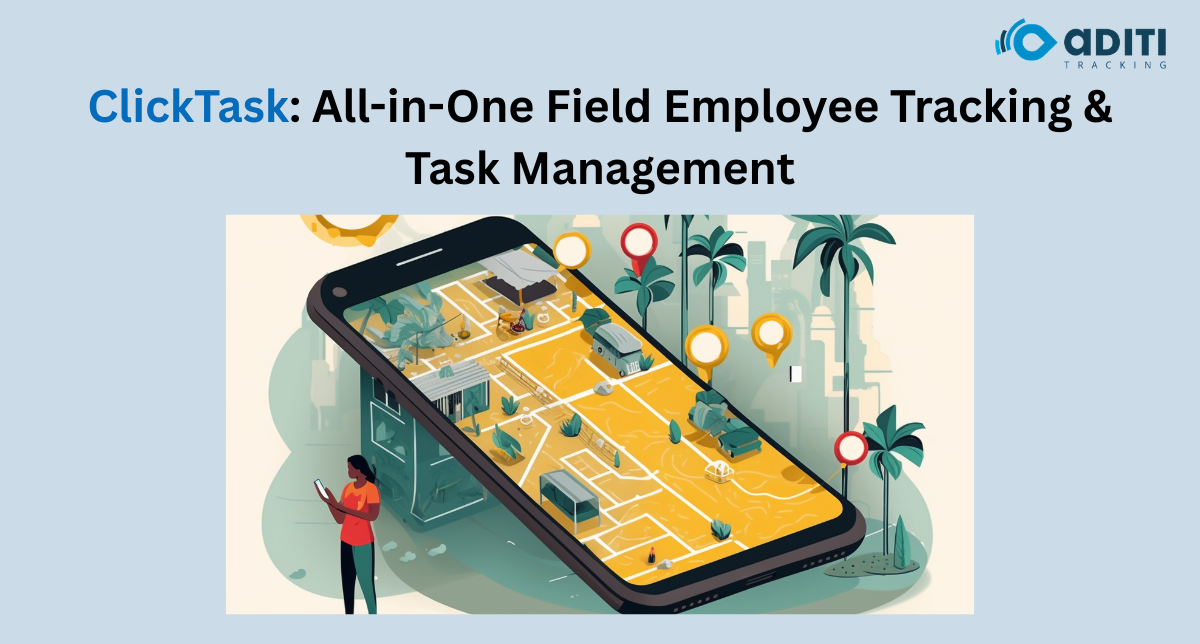
Most companies already have a tracking tool. They also have a task assignment sheet. And a WhatsApp group where the real coordination happens. Three systems, none of them talking to each other, and the operations manager still cannot answer the simplest question at 4 PM on a Tuesday: who finished what, where, and how long did it take? That gap between having tools and having visibility is exactly what a proper field employee tracking app is supposed to close. In most cases, it doesn’t, because the tools were never designed to work as one system.
The Real Problem Is Fragmentation, Not Technology
Indian field operations teams are not short on technology. They have location sharing on personal phones. They have Google Sheets with task lists updated once a day. They have call logs and photo uploads scattered across messaging apps. The technology exists. What does not exist is a single place where location, task status, and performance data come together without someone manually stitching it all.
This is the part that gets overlooked in most “digital transformation” conversations. The bottleneck is not that field employees are untracked. The bottleneck is that tracking, task management, and reporting live in separate silos, and the person responsible for making sense of it all is doing data entry instead of managing operations.
A sales team with 40 field executives across Maharashtra generates hundreds of data points every day. Visit locations, meeting notes, order updates, travel distances. If those data points live in four different apps, nobody analyses them. They sit in exports that never get opened. The intelligence dies in a spreadsheet.
What “All-In-One” Needs To Mean In 2026
The phrase “all-in-one” gets thrown around loosely in enterprise software. Every tool claims it. Few deliver it. For field operations specifically, the bar in 2026 is not what it was even two years ago.
A field employee tracking app that actually earns the label needs to handle a specific set of things without forcing the user into workarounds or third-party patches. The non-negotiables now look like this:
- Real-time location tracking that works on Indian networks, in Tier 2 and Tier 3 towns where connectivity drops frequently, not just in metro areas with full 4G coverage
- Task assignment with priority, deadline, and location attached, pushed directly to the field employee’s phone rather than communicated over a call that gets half-remembered
- Automated status updates as tasks progress, so the manager sees movement without chasing people for confirmations every two hours
- Visit verification through geo-tagged check-ins, timestamps, and photo proof, because self-reported updates are only as reliable as the person reporting them
- End-of-day performance visibility that shows tasks completed, distance covered, time spent per visit, and exceptions flagged, all without requiring manual compilation
Two years ago, companies accepted partial coverage from their tools and filled the gaps manually. That tolerance is disappearing. Operations heads are tired of being the integration layer between three apps that should have been one platform.
Why Tracking Without Task Management Fails
Here is where most standalone GPS tracking apps fall short. They can tell you where someone is. They cannot tell you what that person is supposed to be doing at that location, whether they’ve done it, or what comes next.
Location data without task context is surveillance. It tells the manager that an employee was at a client’s office for 47 minutes but not whether the meeting happened, the order was placed, or the issue was resolved. That distinction matters more than most companies acknowledge, because it is the difference between monitoring bodies and managing outcomes.
A field employee tracking app that combines both gives the manager a completely different kind of control. Not “where is my team” but “what has my team accomplished today, and what is still pending.” That is the shift from tracking to management, and it is the only version of this technology that actually reduces the operational load instead of just adding a dashboard nobody checks after the first month.
Conclusion
The market for field operations platforms in India has grown fast, but most products still lean heavily toward either tracking or task management, rarely both with equal depth. ClickTask was built to sit at that intersection.
ClickTask by Aditi Tracking combines real-time field employee tracking app, task assignment, visit verification, and performance monitoring in one integrated platform built for modern field teams.
Book a Free Demo or Reach Out to Our Team Today to discover how ClickTask can help streamline your field operations and give managers complete visibility into work happening on the ground.
FAQs
1. What is a field employee tracking app?
A field employee tracking app helps businesses monitor employee locations, manage field activities, assign tasks, verify visits, and track productivity in real time through a single platform.
2. Why is combining employee tracking and task management important?
Tracking alone only shows where employees are. When combined with task management, businesses can see what work is assigned, completed, pending, and how efficiently field teams are performing throughout the day.
3. How does ClickTask improve field team productivity?
ClickTask streamlines task assignments, automates status updates, verifies field visits with geo-tagged check-ins, and provides managers with real-time visibility into employee activities, reducing manual follow-ups and reporting delays.
4. Can ClickTask be used by sales and service teams?
Yes. ClickTask is suitable for sales representatives, field service technicians, maintenance teams, delivery staff, auditors, and any organisation that manages employees working outside the office.
5. What features should businesses look for in a field employee tracking platform in 2026?
Businesses should look for real-time location tracking, task assignment and scheduling, geo-tagged attendance, visit verification, automated reporting, performance analytics, and mobile accessibility within a single integrated platform.
 Smart Fleet
 Cool Bus
 Clicktask
 CommutePulse
 Wastetrail