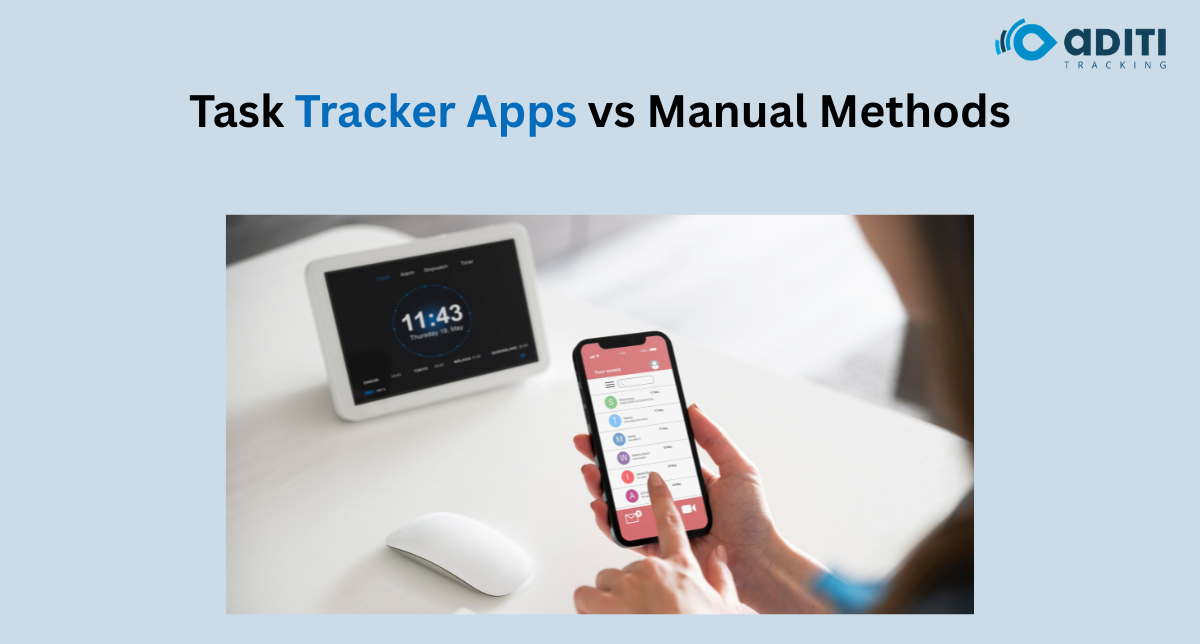
A field executive finishes a job at 2 PM. The report reaches the manager at 6 PM. By then, the next job was already assigned based on a guess, not data. This is what happens when businesses run operations without a task tracker app. The delay between doing the work and recording the work creates a blind spot, and that blind spot costs money every single day.
The Real Problem With Manual Reporting
Manual reporting feels free. No software fees, no onboarding headaches, no IT dependency. But the cost hides inside wasted hours and poor decisions that nobody traces back to the reporting method itself.
Think about a typical field services company in India. Thirty technicians across a city, each filling out paper logs or dropping WhatsApp updates at the end of the day. The operations head pieces together a blurry picture of what happened, never a clear one. What goes wrong is predictable:
- Jobs that took too long don’t get flagged until the next morning, by which point the client has already called to complain, and the damage to the relationship is done
- Travel routes are decided on memory and habit rather than actual location data, which means fuel costs stay high month after month for no good reason
- When a technician calls in sick, reassigning their pending tasks turns into a scramble because nobody has a live view of what’s queued up and what’s already been covered
None of this appears as a line item in the P&L. It shows up as sluggish growth that nobody can quite explain.
What Changes When You Bring In A Task Tracker App
A task tracker app doesn’t just digitise the same broken process. Done right, it restructures how work moves through an organisation.
- Tasks get assigned with location, priority, and deadline attached. Not as a verbal instruction over a phone call that gets half-remembered by the time the technician reaches the site
- Completion updates happen in real time from the field, with timestamps and geo-tags, so the manager sees it the moment it’s done rather than four hours later
- Escalations trigger automatically when a task crosses its deadline. No one needs to remember to follow up
Here’s what most people miss about this. The value isn’t speed alone. It’s the compounding effect of better data feeding better decisions, week after week. When you can see which technician finishes fastest in which area, you start assigning smarter. When you know exactly how long a job type takes on average, you stop overpromising delivery windows to clients.
The Numbers That Should Worry You
Indian SMEs lose roughly 20 to 30 percent of productive field hours to coordination overhead, according to a 2024 NASSCOM digital adoption survey. People waiting for instructions. Duplicating updates across WhatsApp groups. Re-doing work because the brief was unclear.
A task tracker app cuts most of that overhead because the information sits in one place, visible to everyone who needs it. No forwarding. No “I didn’t get the message.” No end-of-day surprises.
And here’s something that doesn’t get discussed enough. Attrition. Field staff in Indian companies often quit because they feel micromanaged over phone calls or penalised for delays that weren’t actually their fault, and when there’s no system tracking what really happened, there’s no way for them to prove otherwise. When task tracking is systematic, the data speaks for itself. A technician who consistently delivers on time has proof. A manager who wants to question performance has specifics, not suspicions.
The Gap Between “We Manage Fine” And Actual Efficiency
Most operations heads will tell you some version of “we manage fine with what we have.” And they do. Things get done. Clients are served.
But managing fine and running an efficient operation are not the same thing. The first means survival. The second means you actually know where your time and money go.
Manual reporting keeps you in survival mode. You react. You fix it. You move to the next fire. A task tracker app with real-time field data, automated escalations, and proper analytics puts you in a position where Tuesday’s problems don’t repeat on Wednesday because someone actually looked at the pattern and fixed the root cause instead of just patching the symptom again.
Conclusion
The question isn’t whether automation helps. That argument ended years ago. The question is how long you keep absorbing the invisible costs of not having it.
ClickTask by Aditi Tracking helps organisations streamline task management, automate updates, improve workforce accountability, and bring complete visibility to field operations through a single platform.
Ready to reduce reporting inefficiencies? Book a Free Demo or Get in Touch Today to see how ClickTask can help your team work more efficiently and eliminate the hidden costs of manual reporting.
FAQs
1. What is a task tracker app, and how does it help businesses?
A task tracker app helps businesses assign, monitor, and manage tasks in real time. It improves visibility, reduces communication gaps, and ensures that managers can track work progress without relying on manual updates.
2. Why is manual reporting less effective than automated task tracking?
Manual reporting often leads to delays, missed updates, and limited visibility into field operations. Automated task tracking provides real-time updates, accurate records, and faster decision-making, helping businesses operate more efficiently.
3. Which industries benefit the most from a task tracker app?
Industries with mobile or field-based teams, such as field services, logistics, sales, maintenance, healthcare, construction, and facility management, benefit significantly from task tracking apps due to the need for real-time coordination.
4. Can a task tracker app improve employee productivity?
Yes. By centralising task assignments, deadlines, and progress updates, a task tracker app reduces time spent on follow-ups, manual reporting, and coordination, allowing employees to focus more on completing their work.
5. How does Clicktask help businesses move beyond manual reporting?
Clicktask provides real-time task tracking, automated alerts, location-based assignments, and performance insights. This helps businesses gain better operational visibility, reduce coordination overhead, and make data-driven decisions across field teams.
 Smart Fleet
 Cool Bus
 Clicktask
 CommutePulse
 Wastetrail