
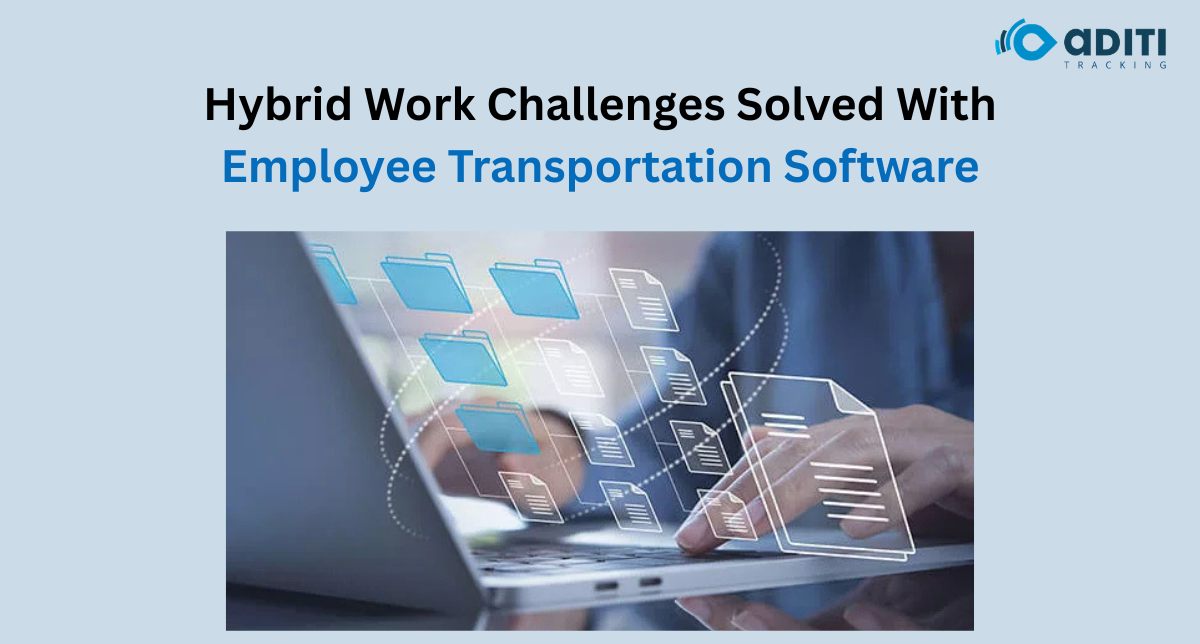
Hybrid work sounded simple on paper. Two days from home, three from the office. Or the reverse. Flexible. Modern. Employee-friendly. What nobody fully accounted for was what this does to transport logistics, and why companies that did not rethink their employee transportation software alongside their work model are now dealing with a very specific kind of daily chaos.
The Hybrid Model Broke The Old Transport Playbook
Traditional employee transport worked on predictability. Fixed shifts. Fixed headcounts per route. The same 40 employees are taking the same cab at 8:15 every morning.
Hybrid killed that.
Now the headcount per shift changes daily. Monday might have 60 employees in the office. Wednesday might have 110. Friday drops back to 45. The cab vendor gets a rough estimate the evening before, sometimes not even that. Routes get shuffled. Vehicles are either overprovided or short.
And somewhere in this confusion, an employee is waiting on the road because the cab that was supposed to pick them up was rerouted without anyone telling them.
This is not a vendor problem. It is a systems problem.
What Hybrid Transport Planning Actually Demands
Managing transport for a hybrid workforce requires three things that most legacy setups simply do not have:
- Day-to-day demand visibility – knowing in advance how many employees need cabs on which days, from which locations
- Dynamic route adjustment – the ability to re-optimise pickup routes based on actual attendance, not last week’s roster
- Real-time communication – employees knowing exactly where their cab is, with zero dependence on a driver’s phone being reachable
Without all three, the admin team is firefighting every single morning.
The companies still running hybrid transport on spreadsheets and WhatsApp groups are not being stubborn. They are working with what they have. But there is a ceiling to what that approach can handle, and most mid-size organisations hit it around the 200-employee mark.
Where Things Break Down In Practice
Here is what a typical week looks like in a company without structured employee transportation software for hybrid work:
Monday, 9 PM the previous night, the admin team is manually updating a shared sheet with Tuesday’s office attendance. Someone misses updating. A pickup point gets dropped. Three employees show up at a location that is no longer on the cab route.
Or this: a last-minute leave by two employees on the same route makes a cab run half-empty while another route is overloaded. Nobody catches it until both cabs are already on the road.
The problem is not that the admin team is doing a poor job. The problem is that the task itself, dynamically managing dozens of routes across variable attendance, is not something a spreadsheet was designed to do.
What Changes When The System Handles It
With the right employee transportation software in place, the daily transport cycle stops being reactive and becomes something closer to managed.
Employees mark attendance or office days through a mobile interface. The system reads that data and builds routes based on actual pickup clusters, not historical assumptions. Seat occupancy gets balanced automatically. The admin team sees a consolidated view before the shift starts, with the ability to adjust if something changes.
On the employee side:
- Live cab tracking from the moment the trip starts
- Automatic notifications for pickup time and arrival
- No dependency on calling the driver or coordinator
On the admin side:
- Actual trip logs replacing vendor-reported data
- Optimised vehicle deployment, reducing idle cabs
- Shift-wise reporting without manual compilation
This is not about replacing human judgment. It is about removing the parts of the process that did not need human judgment in the first place.
The Hybrid Transport Gap Is A Decision, Not A Constraint
Most companies know this problem exists. The ones that have not fixed it are usually waiting for the problem to get bad enough to justify the change. That threshold tends to arrive at the worst possible moment, usually right before an audit, a leadership review, or a safety incident.
The smarter move is to treat transport management as a function that runs on systems, not heroics.
Aditi Tracking’s CommutePulse is built specifically for this. It handles the dynamic, shift-variable demands that hybrid work creates without requiring a large admin overhead to keep it running. If your organisation is still managing hybrid transport manually, CommutePulse is worth a close look.
FAQs
1. Why does hybrid work make employee transport management more difficult?
Hybrid work creates unpredictable office attendance patterns, making it difficult to manage fixed cab routes, vehicle allocation, and shift scheduling using traditional transport methods.
2. How does employee transportation software support hybrid work models?
Employee transportation software helps companies manage changing attendance patterns through automated route planning, real-time scheduling, live tracking, and dynamic seat allocation.
3. What are the biggest transport challenges in hybrid workplaces?
The biggest challenges include fluctuating employee headcounts, inefficient route planning, last-minute schedule changes, communication gaps, and higher transportation costs caused by underutilised vehicles.
4. Can transport management software reduce admin workload in hybrid offices?
Yes. Transport management systems automate attendance-based route planning, trip reporting, employee notifications, and vendor coordination, significantly reducing manual administrative effort.
5. What features are important in hybrid employee transportation software?
Key features include attendance-based route optimisation, real-time cab tracking, automated notifications, shift scheduling, occupancy management, mobile access, and centralized reporting dashboards.


 Smart Fleet
 Cool Bus
 Clicktask
 CommutePulse
 Wastetrail