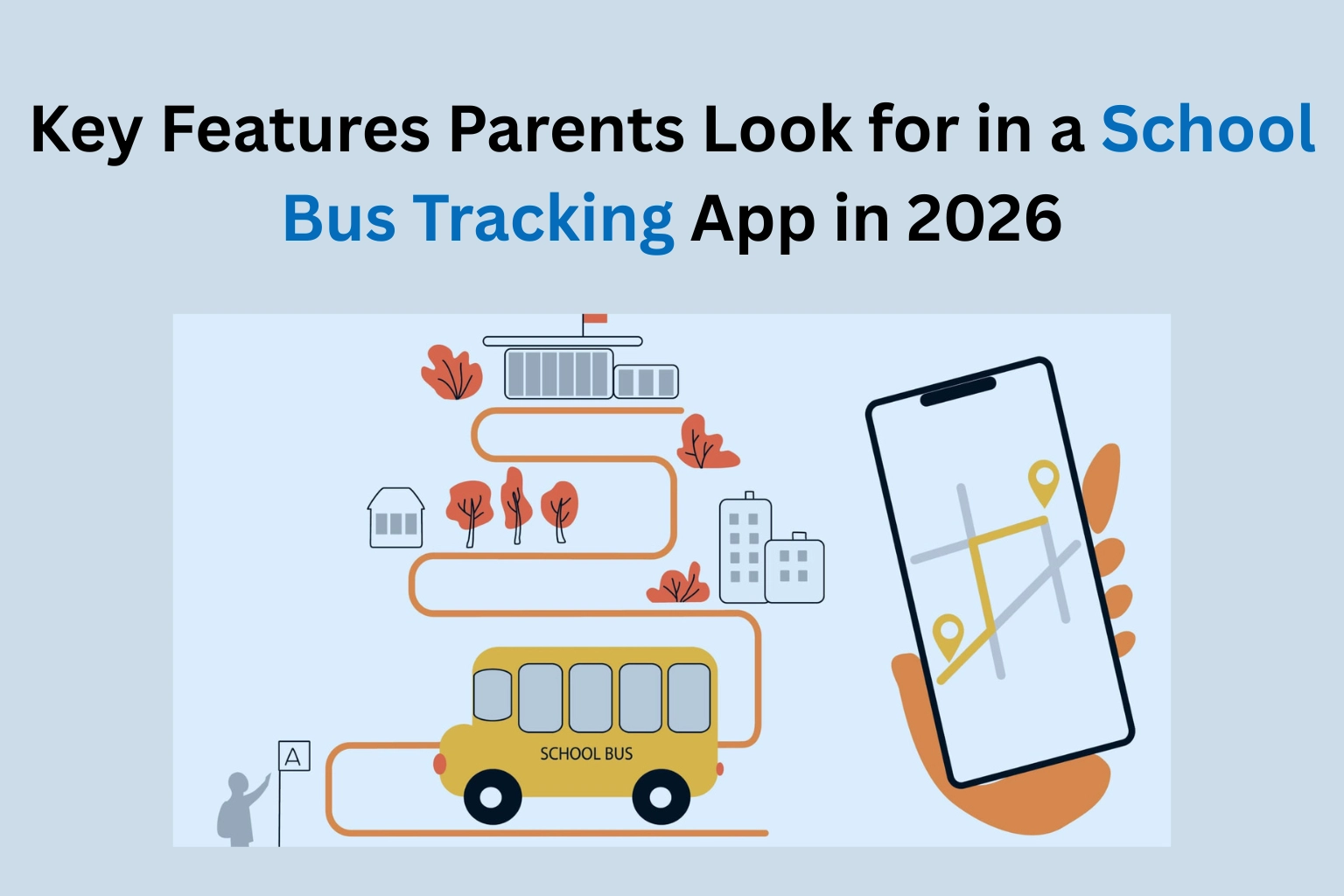
The Indian school transport has taken on a new digital age. In 2026, parents will not want to receive simple SMS notifications or periodic route updates. They would like to have accuracy, transparency and control over the commute of their child in real time. In the case of schools, it will involve the implementation of a powerful school bus tracking app to schools that resonates with current safety-related requirements and technological demands.
This blog discusses the most significant aspects that parents are actively seeking in a modern tracking application and how schools can fulfil these expectations with designed, secure, and smart solutions.
Why Parent Expectations Have Changed
There is a booming increase in the number of school transport in urban India in private schools. There is an intensified traffic density. The time taken to commute to work has become unpredictable. The issue of safety is still of concern.
At the same time, smartphone penetration and digital literacy have grown significantly. Parents today:
- Use banking apps daily
- Track food deliveries in real time
- Monitor ride-hailing vehicles live
It is natural that they expect the same technological maturity from school transport systems.
A school bus tracking app for schools is no longer seen as a premium feature. It is considered basic infrastructure.
1. Real-Time Live Tracking with High Accuracy
The first and most important feature parents expect is accurate live tracking.
This includes:
- Real-time vehicle location on a map
- Minimal latency in updates
- Clear route visualisation
- Estimated time of arrival at pickup points
Accuracy matters. Delays of even a few minutes in the update refresh can create confusion.
Parents want confidence that the tracking app reflects actual bus movement, not outdated GPS data.
Schools must ensure that the underlying GPS hardware and software infrastructure support high-frequency data transmission with stable network connectivity across urban and semi-urban regions.
2. Automated Pickup and Drop Notifications
Manual communication is no longer acceptable.
Parents expect automated alerts when:
- The bus is approaching the pickup point
- The child has boarded the bus
- The bus has reached school
- The child has safely exited the bus
Advanced systems integrate RFID cards or smart attendance modules. When a student boards or disembarks, the event is logged instantly.
This creates:
- A digital audit trail
- Reduced ambiguity
- Immediate reassurance for parents
In Indian cities where morning schedules are tightly managed, timely alerts significantly improve daily coordination.
3. Geofencing and Route Deviation Alerts
Geofencing is becoming a standard feature in a modern school bus tracking app for schools.
Parents want assurance that:
- The bus follows its designated route
- Unauthorised deviations trigger alerts
- Pickup and drop zones are clearly defined
When a bus exits a predefined route or crosses a safety boundary, administrators and, in some configurations, parents receive notifications.
For parents, this feature signals proactive safety monitoring rather than reactive problem-solving.
4. Driver Behaviour Monitoring Transparency
Safety is not limited to location tracking. Parents are increasingly aware of driver conduct and road discipline.
Tracking applications in 2026 are expected to support:
- Speed monitoring
- Over-speed alerts
- Harsh braking detection
- Sudden acceleration reports
While parents may not require detailed analytics dashboards, they want confidence that the school actively monitors these parameters.
Transparency builds trust.
Schools that communicate that driver behaviour is digitally monitored demonstrate commitment to student safety.
5. Panic Button and Emergency Alerts
Emergency readiness is a non-negotiable feature.
Parents expect the tracking app to include:
- Panic button integration
- Immediate notification in case of an emergency
- Real-time bus location during incidents
- Instant communication channels
In critical situations such as vehicle breakdowns, medical emergencies, or traffic incidents, rapid awareness reduces anxiety and improves coordinated response.
An advanced school bus tracking app for schools integrates these emergency workflows within the mobile interface.
6. Multi-Child and Multi-Route Management
Many Indian families have more than one child attending the same school or different branches.
Parents prefer apps that:
- Allow monitoring of multiple children under one account
- Provide separate route tracking per child
- Offer consolidated notification management
User interface design must be intuitive. Parents should not navigate complex menus to access basic transport information.
User experience directly impacts app adoption.
7. Data Security and Privacy Protection
With increasing awareness around data protection, parents are more cautious about how their child’s location data is handled.
They expect:
- Secure login authentication
- Encrypted communication
- Controlled data sharing
- No unauthorised third-party access
Schools must partner with vendors that follow secure cloud hosting practices and comply with Indian data governance standards.
A secure architecture is as important as feature richness.
8. Minimal App Downtime and Reliable Performance
Parents judge reliability based on consistency.
If the tracking app frequently crashes, fails to load, or shows inaccurate updates, trust erodes quickly.
A high-quality school bus tracking app for schools must ensure:
- Scalable server infrastructure
- Strong backend uptime
- Optimised mobile performance
- Cross-platform compatibility for Android and iOS
Technology reliability influences institutional reputation.
9. Transparent Communication During Delays
Traffic disruptions are inevitable in Indian cities.
Parents do not expect perfection. They expect communication.
A modern app should provide:
- Automated delay notifications
- Updated ETA calculations
- School-issued broadcast messages
Silence during delays creates frustration. Proactive communication strengthens confidence.
10. Integration with Broader School Systems
In 2026, parents expect digital ecosystems, not isolated apps.
A mature tracking platform integrates with:
- School ERP systems
- Attendance modules
- Communication portals
For example, transport attendance discrepancies can align with school entry logs. This integrated intelligence enhances safety oversight.
Schools that adopt integrated platforms position themselves as digitally advanced institutions.
Why Schools Must Align with These Expectations
Parent perception influences:
- School admissions
- Word-of-mouth reputation
- Brand trust
- Long-term institutional growth
Offering a technologically robust transport tracking solution demonstrates operational maturity.
In competitive urban education markets, digital infrastructure can be a differentiator.
Investing in a reliable school bus tracking app for schools signals that safety and transparency are strategic priorities.
Why Consider Aditi Tracking
When evaluating tracking solutions, domain expertise matters. School transportation has unique operational requirements that differ from commercial fleet tracking.
Aditi Tracking brings extensive experience in telematics and institutional fleet management across India. The company provides structured GPS-based tracking architectures designed for school environments.
With Aditi Tracking, schools can access:
- Real-time GPS monitoring systems
- Parent-friendly mobile applications
- Geofencing and speed monitoring features
- Compliance-ready reporting
- Secure data infrastructure
- Professional deployment and support services
Schools can also adopt a tracking system that will meet the 2026 expectations of parents through collaboration with a dedicated provider such as Aditi Tracking.
Final Thoughts
The development of digital infrastructure has transformed the parental expectation of school transport. Live tracking, instant notifications, emergency preparedness, and safe data processing are no longer the features of the option.
They define baseline standards.
In the context of Indian schools that need to create trust and improve security and operational transparency, introducing a powerful school bus tracking application to schools is a tactical requirement.
When technology is applied in a considered manner, transport becomes a logistical operation, as opposed to a safety guarantee system.

 Smart Fleet
 Cool Bus
 Clicktask
 CommutePulse
 Wastetrail