
In India, school transport has ceased to be an easy work activity. It is a safety critical system which directly affects the well-being of students, trust of parents and reputations of institutions. As urban traffic increases, the state policies are becoming more strict, and the demands of the parents are growing, schools need to modernise their transport infrastructure.
A dedicated school bus tracking software solution is not merely a technological enhancement. It is a structured, data-driven safety framework designed specifically for educational institutions.
This blog explores why Indian schools should transition from generic GPS tools to purpose-built transport management systems.
The Problem with Traditional and Generic Tracking Systems
Many schools believe they are technologically equipped because their buses have GPS devices installed. However, there is a fundamental difference between a basic vehicle tracking system and a specialised school bus tracking software platform.
Generic GPS tracking typically provides:
- Vehicle location visibility
- Route history playback
- Basic speed alerts
While useful, these features are not sufficient for managing student transportation. School transport requires student-level monitoring, parent communication, compliance documentation, and emergency protocols.
A dedicated solution addresses these unique requirements.
Student Safety as the Primary Driver
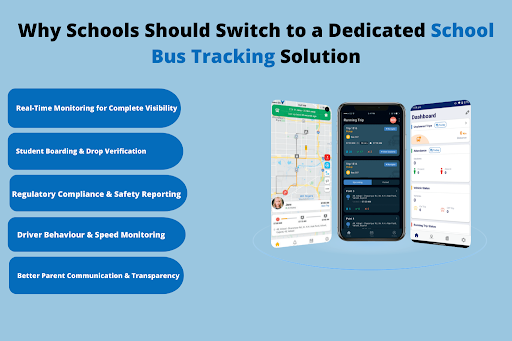
Real-Time Monitoring for Administrators
With school bus tracking software, transport managers can monitor every vehicle from a central dashboard. They can identify:
- Route deviations
- Unexpected stoppages
- Delays due to congestion
- Over-speeding incidents
This continuous monitoring reduces risk and allows for immediate corrective action.
In densely populated Indian cities such as Delhi, Mumbai, Bengaluru, or Hyderabad, real-time visibility is not optional. It is essential.
Parent Transparency and Communication
Today’s parents expect accountability. Waiting indefinitely at a pickup point without information creates anxiety and frustration.
Dedicated tracking platforms provide:
- Live bus tracking via mobile applications
- Estimated time of arrival notifications
- Alerts when the bus reaches a specific stop
- Automated delay notifications
This level of communication enhances trust and significantly reduces administrative phone calls.
Student Boarding and Drop Confirmation
Advanced school bus tracking software integrates RFID or smart ID tagging systems. When a student boards or exits the bus:
- The event is digitally recorded
- Parents receive instant notifications
- Attendance logs are automatically updated
This eliminates ambiguity regarding student transit and ensures a verifiable safety trail.
In emergency scenarios, administrators can instantly determine which students are on a specific bus.
Regulatory Compliance in the Indian Context
Several Indian states mandate safety protocols for school transport. These often include:
- GPS tracking requirements
- Speed monitoring
- CCTV integration
- Emergency response mechanisms
A dedicated tracking solution centralises compliance data. It provides:
- Speed violation reports
- Trip history records
- Route audit logs
- Driver behaviour analytics
For school management boards, this reduces regulatory risk and simplifies inspections.
Enhancing Driver Accountability
Driver behaviour plays a critical role in student safety. A specialised system can monitor:
- Harsh braking
- Sudden acceleration
- Speed limit violations
- Idle time
This data enables transport heads to conduct performance reviews and implement corrective training when necessary.
By combining technology with behavioural oversight, schools create a structured safety culture.
Route Optimisation and Risk Reduction
Indian road conditions are dynamic. Traffic patterns change frequently, and unexpected diversions are common.
Dedicated school bus tracking software uses route analytics to:
- Identify high-risk traffic zones
- Reduce travel time
- Minimise unnecessary detours
- Improve pickup sequencing
Efficient routing not only reduces fuel costs but also decreases student exposure time on busy roads.
Safety improves when operational efficiency improves.
Emergency Response Capabilities
A modern tracking system includes panic button integration. In case of:
- Medical emergencies
- Vehicle breakdowns
- Security threats
The system transmits real-time location data to school authorities.
Immediate awareness accelerates response time, which is crucial in critical situations.
For schools operating large fleets, this feature provides operational control that manual systems cannot match.
Data Security and Governance
Student location data is highly sensitive. Schools must prioritise cybersecurity when selecting a vendor.
A reliable school bus tracking software platform should offer:
- Encrypted data transmission
- Secure cloud hosting
- Role-based access controls
- Compliance with Indian data protection guidelines
IT administrators must evaluate system architecture before deployment. Security cannot be an afterthought.
Reducing Administrative Burden
Transport coordination without automation often involves:
- Manual attendance reconciliation
- Frequent phone communication
- Spreadsheet-based reporting
- Delayed incident documentation
A dedicated solution automates these tasks.
Transport coordinators can generate:
- Daily trip summaries
- Exception reports
- Performance dashboards
This reduces human error and allows staff to focus on safety oversight rather than repetitive administrative tasks.
Scalability for Growing Institutions
Many Indian schools are expanding their fleets as enrolments increase. Managing 5 buses is very different from managing 25.
A scalable school bus tracking software platform supports:
- Multi-branch monitoring
- Centralised fleet dashboards
- Custom route segmentation
- Modular feature upgrades
Investing in scalable technology today prevents expensive system migrations in the future.
Financial and Strategic Benefits
While safety is the primary objective, schools also benefit financially through:
- Reduced fuel wastage
- Lower accident-related expenses
- Optimised fleet utilisation
- Improved insurance negotiations
More importantly, technology-driven safety infrastructure enhances institutional reputation.
Parents increasingly consider transport safety when evaluating schools. Transparent digital systems strengthen brand positioning.
Implementation Best Practices
To ensure successful adoption, schools should:
- Conduct a transport risk assessment
- Select hardware suited for Indian road conditions
- Pilot test routes before full deployment
- Train drivers and administrators thoroughly
- Educate parents about mobile application usage
Technology must integrate with well-defined processes.
Why Forward-Thinking Schools Choose Aditi Tracking as a Safety Infrastructure Partner
The selection of a proper technology partner is very important. There is a great difference between school transport management and commercial logistics tracking.
Aditi Tracking has developed competence in institutional fleet management and telematics in India. The company offers strong tracking architectures that are designed to support a structured setting like a school.
Through collaborating with Aditi Tracking, schools have access to:
- Reliable GPS hardware integration
- Real-time monitoring dashboards
- Parent notification modules
- Geofencing and speed analytics
- Compliance-ready reporting systems
- Professional installation and technical support
The domain-specific strategy of Aditi Tracking makes sure that the safety, transparency, and operational efficiency are the key points of the solution.
Final Thoughts
The Indian schools are characterised by complexity, regulation, and increasing expectations. The past system of tracking is no longer adequate to guarantee the safety of the students.
Replacing general school bus tracking software with dedicated school bus tracking software will turn school transport into an active safety system that is data-driven. It enhances visibility, compliance, improves communication, and limits risk.
Investment in institution-specific transport tracking is not only a technological decision in institutions that take the protection of students and preserving parental trust seriously. It is a strategic obligation.


 Fleet Management
 Cool Bus
 Clicktask
 CommutePulse
 Wastetrail