

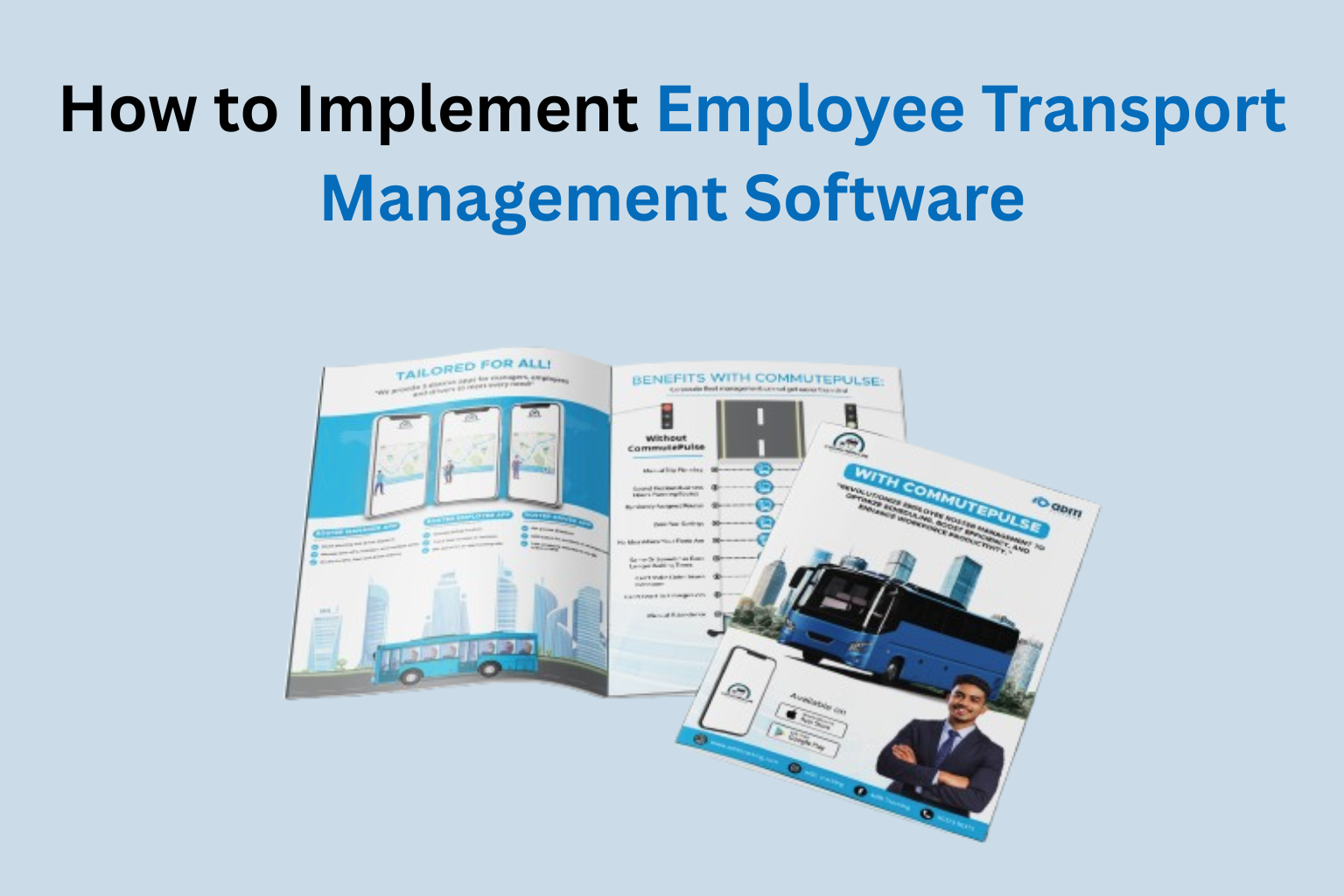
Most corporate transport implementations fail before they begin. Not because the technology is wrong. Because the implementation is treated as an IT project when it is actually an operations project. CommutePulse by Aditi Tracking is employee transportation management software built for the way Indian corporate fleets actually work, and implementing it correctly is a process, not an event.
The Implementation Problem Nobody Warns You About
There is a large insurance company in Bengaluru. Four hundred employees across two shifts. They purchased a transport management platform two years ago. Spent three months integrating it. Launched it with a company-wide announcement.
Six weeks later, the HR team was back to managing routes on a spreadsheet. The platform was technically running. Nobody was using it.
The technology was not the problem. The rollout was.
Employee transportation management software does not implement itself. It requires a structured approach that accounts for three things most vendors ignore: the data that needs to exist before the system goes live, the people who need to trust the system before they use it, and the operational workflows that need to change, not just the tools.
CommutePulse is built on Aditi Tracking‘s 14 years of telematics deployment experience across Indian fleets. That experience shapes not just the product, but the way we approach implementation. A system that does not get adopted does not get results. Adoption is an implementation problem, not a product problem.
This guide walks through how to implement CommutePulse correctly, from the decisions that need to happen before Day One, through to the metrics that tell you it is working.
Phase One: Get the Data Right Before the System Goes Live
The Master Data Problem
Every employee transportation management software implementation runs on master data. Employee names, designations, home addresses, shift timings, pickup preferences. This data is almost always messier than the transport team expects.
Addresses are approximate. Shift assignments are outdated. Some employees have relocated and not told HR. Some listed addresses are relatives’ homes used as correspondence addresses, not actual pickup locations.
Before CommutePulse goes live, this data needs to be clean. Not perfect, clean. There is a difference.
Three steps make this manageable:
First
Export the current employee database and cross-reference it against the latest HR records. Flag every address that has not been verified in the last six months.
Second
Run a quick employee verification exercise, a simple form sent to all transport-eligible employees asking them to confirm their current pickup address, preferred pickup time window, and shift. This takes a week and saves months of route correction after launch.
Third
Map vendor assignments against the clean employee list. Every route needs a confirmed vendor, a confirmed vehicle, and a confirmed driver before the system goes live. CommutePulse cannot optimize routes it does not know exist.
Hardware Installation: The Non-Negotiable First Step
CommutePulse is employee transportation management software, but it runs on hardware. The GPS tracking units installed in every vendor vehicle are the source of the live location data that makes the system work.
Aditi Tracking manages this installation directly. The hardware is AIS-140 compliant, tested for Indian road conditions, and designed to maintain signal integrity across the connectivity variability that any multi-city deployment encounters.
Installation timelines depend on fleet size and vendor cooperation. For most corporate deployments, hardware installation across 30 to 60 vehicles takes three to five working days. Vendor cooperation is the variable, and it is worth addressing directly.
Some vendors resist installation because they understand that a tracked vehicle is an accountable vehicle. This is a conversation the transport manager needs to have explicitly: tracking is a condition of the contract, not a request. CommutePulse’s vendor data is used for invoice reconciliation, and vendors who do not participate in the system do not get reconciled invoices that are not verified.
That framing usually resolves vendor hesitation quickly.
Phase Two: Configure the System for Your Actual Operations
Route Building: The Logic That Lives Inside CommutePulse
Once the master data is clean and the hardware is installed, route building begins. This is where employee transportation management software either earns its value or wastes it.
Generic route building treats employee locations as coordinates and optimizes for distance. CommutePulse adds operational context: shift timing constraints, maximum acceptable travel time per employee, gender-based co-travel compliance requirements, and pickup sequence logic that accounts for real traffic patterns rather than map distances.
App Onboarding: The Adoption Moment
Employee adoption of the CommutePulse app is the single most important variable in whether the implementation delivers value. An employee who does not use the app does not get live cab location. Does not get arrival notifications. Cannot submit feedback or trigger an SOS.
The onboarding approach matters enormously here.
One option is a top-down mandate: IT pushes the app, HR sends a circular, employees are expected to comply. This approach produces installs. It does not always produce usage.
The second option is a demonstration-led rollout: transport coordinators run short, floor-level sessions where employees see the app working before they are asked to use it. They see their cab moving on the map. They see what the arrival alert looks like. They understand what they get from the system, not just what the system asks of them.
The second approach consistently produces higher adoption rates. It takes an additional week. The payoff is a team that uses the tool rather than ignores it.
Phase Three: Run the First Month as a Calibration Exercise
Expect Imperfection. Correct Quickly.
No corporate fleet goes live on employee transportation management software and operates perfectly from Day One. Routes that looked optimized in configuration reveal real-world friction. A pickup point that seemed logical is actually unreachable during peak traffic. A vendor whose vehicles were hardware-installed is logging trips with consistent GPS drift.
The first month is a calibration month. Not a failure. Not a reflection on the system. A necessary operational learning period that every honest implementation acknowledges.
Aditi Tracking‘s implementation support runs actively through the first 30 days. The focus is on three things: data accuracy (are the GPS readings matching actual routes?), route performance (are employees arriving on time?), and vendor compliance (are all trips being logged and reconciled correctly?).
Issues that surface in this month are fixed in this month. By Day 45, most corporate deployments are running at full operational stability.
The Metrics That Tell You It Is Working
Implementation success is not a feeling. It is a number. Three numbers, specifically:
Route occupancy rate
The average number of employees per vehicle per trip. A well-configured CommutePulse deployment targets 75 percent or above. Below 60 percent signals underutilized routes that need redesign.
On-time pickup rate
The percentage of pickups completed within the defined time window. A baseline below 80 percent in the first month usually traces to route sequencing issues or vendor performance gaps. Both are fixable with the data CommutePulse provides.
Employee app engagement rate
The percentage of transport-eligible employees actively using the CommutePulse app. Target 70 percent by the end of Month One. Below 50 percent indicates an adoption problem that requires a second onboarding effort, not a technical fix.
What Happens After Go-Live Is What Separates Good Implementations from Great Ones
Most implementation guides end at launch. That is precisely where the real work begins.
CommutePulse is not a set-and-forget deployment. The operational environment it manages changes continuously: employees join and leave, addresses change, vendors underperform, shift compositions shift seasonally. The transport manager who treats CommutePulse as a configured system rather than a live operational tool will find the system drifting out of alignment with reality within six months.
The companies that extract the most value from CommutePulse treat the platform the way Aditi Tracking built it to be treated, as an operations tool that requires monthly data hygiene, quarterly route reviews, and ongoing vendor performance management.
The difference between a corporate fleet that is administered and one that is genuinely managed comes down to this: does the system reflect what is actually happening, or does it reflect what was configured to happen six months ago?
Implementation is how you start. Operational discipline is how you sustain the value.
There is a reason Aditi Tracking’s implementation team stays involved through the first month and remains available beyond it. Not because the software needs hand-holding. Because good implementation is a partnership between a system that tracks and a team that acts on what the tracking reveals.
CommutePulse gives you visibility. The decision to use it properly, that one is yours.
 Fleet Management
 Cool Bus
 Clicktask
 CommutePulse
 Wastetrail