
In India, transportation of schools is not only a logistical activity. It is a duty that includes the safety of students, trust of parents, adherence to regulations and the responsibility of institutions. As traffic jams grow in the city, safety demands keep on increasing, as well as the levels of digitisation in the various fields of education, schools have to upgrade their transport systems.
One of the most effective ways to strengthen student safety is through GPS school bus tracking. Used properly, it will turn school transportation into a real-time, intelligence-driven, proactive system of safety and security.
This blog discusses the way Indian schools can use GPS-enabled tracking to develop a safer and more transparent transport system.
Why School Transport Safety Needs a Technology Upgrade
Indian cities face unique challenges:
- Dense traffic conditions
- Unpredictable road delays
- Increasing school fleet sizes
- Heightened parental awareness
- Strict safety mandates from state authorities
Traditional transport monitoring methods such as manual attendance sheets, driver phone coordination, and paper-based logs are insufficient in this environment.
Safety today requires:
- Real-time vehicle visibility
- Automated monitoring
- Digital attendance verification
- Instant communication capabilities
This is precisely where GPS school bus tracking plays a central role.
What Is GPS-Enabled School Bus Tracking?
At its core, GPS school bus tracking integrates satellite-based positioning systems with cloud software dashboards and mobile applications.
The architecture typically includes:
- GPS hardware installed in buses
- SIM-enabled data transmission modules
- Cloud-based fleet management software
- Parent and school administrator mobile apps
- Alert and notification engines
Unlike generic vehicle tracking, school-focused platforms include features tailored for student transport safety and compliance.
Key Ways GPS Tracking Enhances Child Safety
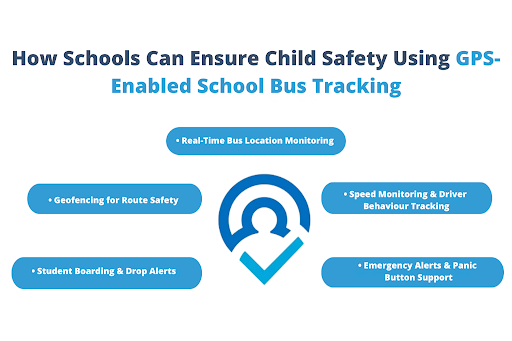
1. Real-Time Bus Location Monitoring
The primary safety advantage is live vehicle tracking.
School administrators can:
- Monitor all buses simultaneously
- Identify route deviations instantly
- Track delays in real time
Parents receive live updates about bus arrival times, reducing uncertainty and unnecessary waiting at pickup points.
This visibility layer significantly reduces anxiety and enhances situational awareness.
2. Geofencing for Safe Zones
Geofencing allows schools to create virtual boundaries around:
- School premises
- Pickup and drop points
- Designated transport routes
If a bus deviates from its assigned route or exits predefined zones, administrators receive instant alerts.
For Indian urban environments where route diversions can pose safety concerns, geofencing acts as a digital safeguard.
3. Speed Monitoring and Driver Behaviour Analytics
Overspeeding remains one of the primary risks in school transportation.
A robust GPS school bus tracking system continuously monitors:
- Vehicle speed
- Harsh braking events
- Sudden acceleration
- Prolonged idling
Schools can set speed thresholds based on local regulations. Any violation triggers real-time notifications.
This ensures:
- Improved driver accountability
- Reduced accident risk
- Safer driving behaviour
In many states across India, transport authorities mandate speed governors. GPS tracking complements these by providing digital evidence and audit trails.
4. Student Boarding and Drop Verification
Advanced systems integrate RFID cards or biometric attendance tagging.
When a child boards or exits the bus:
- The system logs the event
- Parents receive an instant notification
- Digital attendance records are updated
This eliminates ambiguity regarding whether a student has safely boarded or disembarked.
In rare emergency scenarios, administrators can quickly identify which students are on a specific bus at any given time.
5. Panic Button and Emergency Escalation
Modern GPS school bus tracking solutions include emergency features such as:
- Panic buttons for drivers
- Immediate location sharing
- Automated alert escalation
In case of breakdowns, medical emergencies, or security threats, the system provides instant coordinates to school authorities and, if configured, to local emergency responders.
This rapid response capability can be critical in time-sensitive situations.
Enhancing Parent-School Communication
In the Indian context, parental trust significantly influences school reputation.
GPS-enabled systems enhance communication through:
- Live bus tracking apps
- Automated arrival alerts
- Delay notifications
- Emergency broadcasts
Instead of repeated phone calls to the school office, parents receive structured digital updates.
This improves:
- Administrative efficiency
- Transparency
- Institutional credibility
Schools that invest in transport transparency demonstrate proactive governance.
Supporting Regulatory Compliance in India
Many Indian states have issued school bus safety guidelines that include:
- GPS tracking mandates
- CCTV installation requirements
- Speed monitoring compliance
- Verified driver records
A dedicated GPS school bus tracking system helps schools meet these mandates by providing:
- Trip history reports
- Speed violation logs
- Route analytics
- Audit-ready digital documentation
For school management, this reduces regulatory risk and simplifies inspections.
Data Security and Privacy Considerations
Student location data is highly sensitive.
Schools must ensure that their chosen solution offers:
- Encrypted communication channels
- Secure cloud infrastructure
- Role-based access controls
- Indian data protection compliance
Technology adoption should always be accompanied by clear data governance policies.
Choosing a vendor with proven enterprise-grade security architecture is essential.
Operational Benefits That Indirectly Improve Safety
While safety is the primary objective, GPS school bus tracking also improves operational efficiency.
Route Optimisation
By analysing traffic patterns and route performance, schools can:
- Reduce travel time
- Avoid high-risk congestion zones
- Minimise unnecessary detours
Efficient routing directly enhances student safety by reducing exposure time on roads.
Predictive Maintenance Alerts
Some platforms provide vehicle health monitoring integration.
Early detection of maintenance issues prevents breakdowns during student transit, which can otherwise create unsafe situations.
Implementation Best Practices for Indian Schools
To maximise safety impact, schools should:
- Conduct a transport risk assessment before deployment
- Select hardware certified for Indian road conditions
- Train drivers and transport coordinators thoroughly
- Pilot the system on select routes before full rollout
- Educate parents about mobile app usage
- Establish internal SOPs for emergency alerts
Technology alone is not sufficient. Proper process integration ensures effectiveness.
The Long-Term Impact of GPS-Based Transport Safety
Schools that adopt structured GPS school bus tracking systems benefit from:
- Reduced accident exposure
- Higher parent satisfaction
- Improved brand perception
- Stronger compliance alignment
- Data-driven decision making
In a competitive education landscape, operational safety maturity becomes a differentiator.
Safety is no longer managed manually. It is managed through data.
Why Schools Should Consider Aditi Tracking
Domain knowledge is important when choosing a transport technology partner. The transport associated with schools needs dedicated safety procedures that are not similar to the work of commercial fleets.
Aditi Tracking has become an accredited telematics and fleet intelligence company in India. Having a rich background in GPS based vehicle tracking and implementation in fleet within institutions, the company has provided structured solutions to a school setting.
Schools partnering with Aditi Tracking gain access to:
- Reliable GPS hardware integration
- Real-time monitoring dashboards
- Parent notification modules
- Geofencing and speed analytics
- Compliance-ready reporting tools
- Professional installation and support services
Aditi Tracking can provide a modernisation and security-oriented solution to Indian educational institutions that want to modernise their transport safety infrastructure.
Final Thoughts
Child safety on the way is not a negotiable point for schools. As urban and parental pressures increase, it is no longer possible to use the old style of monitoring systems.
The GPS school bus tracking offers the technological foundation that is needed to ensure real-time visibility, compliance with regulations and proactive safety control.
For Indian schools that hold the protection of students as a priority and that also seek to establish a trust-based institution, implementing a well-organized GPS-powered tracking system is not just a modification. It is a strategic imperative.


 Fleet Management
 Cool Bus
 Clicktask
 CommutePulse
 Wastetrail