

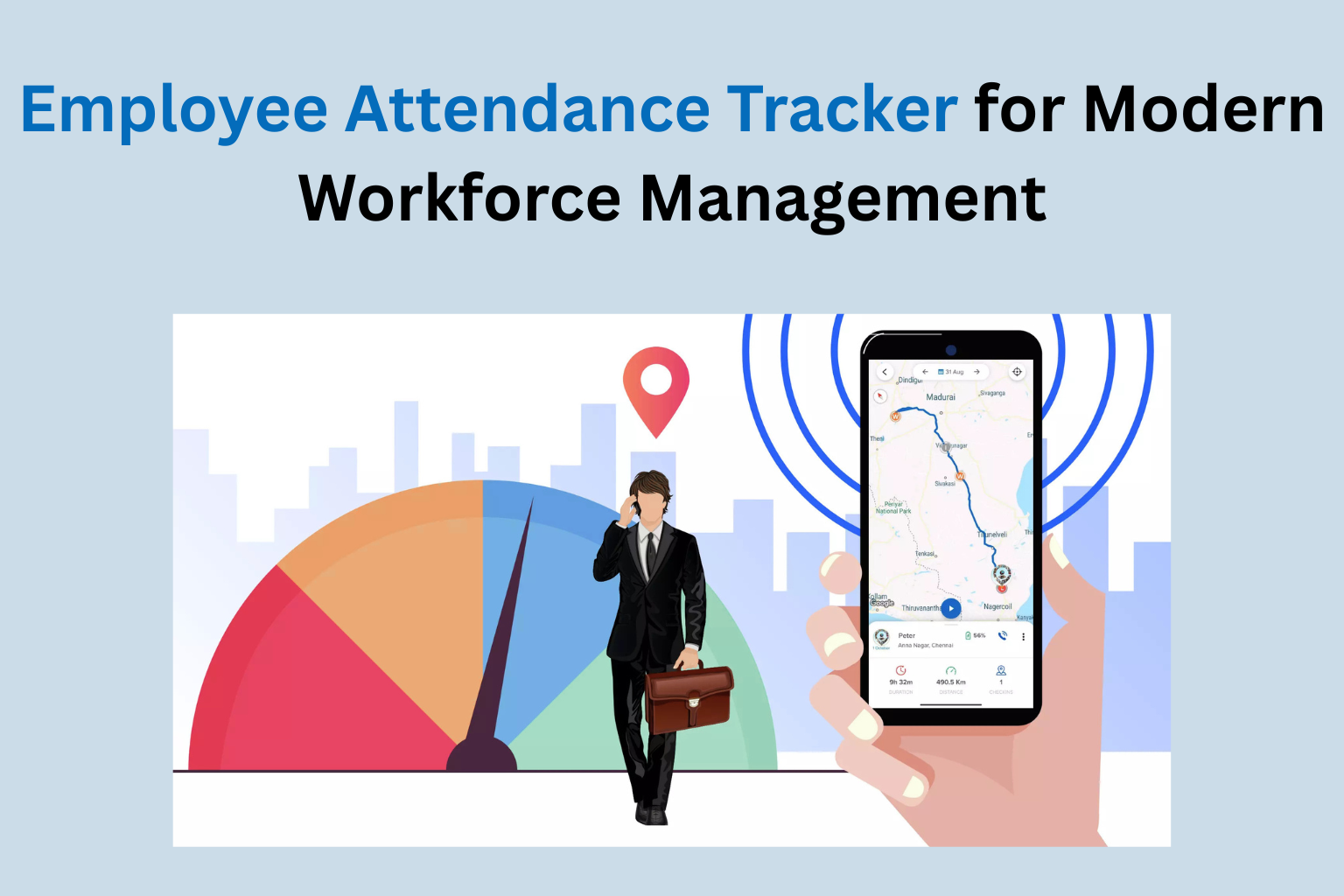
Attendance is the most basic operational data a business collects. And somehow, it is also among the most unreliable. The punch card said everyone showed up. The register says everyone signed in. The geo-tagged selfie says everyone was at the right location at 9 AM. None of these systems tell you what actually happened between mark-in and mark-out. An Employee Attendance Tracker built for modern workforce realities does not just record presence. It verifies it.
The Attendance Problem Is Not What Most Managers Think It Is
There is a pharmaceutical distribution company in Hyderabad. Sixty field representatives. Every morning, they mark attendance through a mobile app. The HR dashboard shows 58 present, 2 on leave. The numbers look clean.
By 11 AM, four of those 58 are at home. Two more are running personal errands. The remaining 52 are working, with wildly different levels of productivity across territories the company cannot see from its office.
The attendance system said 58 people showed up. The operational reality was something different.
This gap, between recorded attendance and actual productive presence, is the real workforce monitoring challenge. It is not a fraud problem, though fraud exists. It is a structural problem. Systems designed to record a moment cannot describe a day.
Most businesses in India manage attendance the way they managed it in 1995, they record when people arrive and when they leave, and fill the gap between those two timestamps with trust. That trust is often warranted. But trust without verification is not a management system. It is optimism wearing a spreadsheet.
An Employee Attendance Tracker that closes this gap does not replace trust. It gives trust a foundation.
Why Traditional Attendance Systems Break Down in Modern Workforces
The Fixed-Location Assumption
Every traditional attendance system, biometric scanners, punch cards, desktop login timestamps, is built on a fixed-location assumption. The employee comes to a specific place. The system records it. The logic is clean.
Modern workforces do not operate on a fixed-location assumption. Field sales teams, service technicians, delivery executives, site supervisors, medical representatives, they work everywhere except a fixed desk. Requiring them to report to a central location to mark attendance before dispersing defeats the operational logic of a field role entirely.
And yet, without a location-aware Employee Attendance Tracker, these companies have no alternative. They build workarounds. Managers call to verify location. WhatsApp messages with location pins get shared as proof. Supervisors do spot checks. The system costs more in management time than the problem it is trying to solve.
The Static Snapshot Problem
Even for teams that do work from fixed locations, traditional attendance systems record a snapshot. Present at 9:02 AM. Left at 6:14 PM. What happened in between is invisible.
For knowledge workers in offices, this gap is manageable, their output is visible through work products. For field employees, where the work product is a visit made, a delivery completed, a site inspected, the gap between clock-in and clock-out is the entire job.
An Employee Attendance Tracker that only records entry and exit is tracking payroll eligibility, not workforce productivity. These are related but not identical.
The Verification Vacuum
Geo-tagged selfies were the industry’s first attempt to solve the location verification problem. They solved half of it. A geo-tagged selfie proves the employee was at a location at the moment the photo was taken. It proves nothing about where they went afterward.
The verification vacuum is not filled by a selfie. It is filled by continuous location tracking across the working day, paired with task assignment and completion data that contextualizes the location record.
What a Modern Employee Attendance Tracker Actually Tracks
ClickTask by Aditi Tracking is built on this understanding. It functions as an Employee Attendance Tracker that records presence, and as an operational platform that makes presence meaningful.
Attendance With Location Context
Mark-in through ClickTask captures GPS coordinates at the moment of attendance marking. But unlike geo-tagged selfies, ClickTask continues tracking location across the working day against the employee’s assigned beat plan or task schedule.
The result is not a single coordinate. It is a location trail that shows where the employee was throughout the day, which assigned locations they visited, how long they stayed, and where they went between tasks.
Task Completion as Attendance Verification
The most meaningful verification of productive attendance is not location. It is task completion in location.
ClickTask links attendance to task assignment from the start of the day. An employee who marks attendance and then does not engage with any assigned tasks within the expected time window generates an automatic flag. The manager does not need to call. The system signals that something is off.
This closes the gap between recorded attendance and actual productive presence, not by assuming the worst about employees, but by creating operational clarity that benefits everyone. Employees who are working have their work verified. Employees who are not are surfaced early enough for a manager to intervene constructively.
Overtime and Compliance Tracking Without Manual Compilation
One of the most time-consuming HR functions in companies with field teams is overtime verification. An employee claims three hours of overtime on a day that the location data shows them finishing their last task at 4:30 PM.
Without a reliable Employee Attendance Tracker, this dispute is resolved through negotiation, uncomfortable for the manager, resented by the employee regardless of outcome. With ClickTask, the location trail and task completion timestamps are the record. The conversation becomes factual rather than adversarial.
Beyond overtime, compliance with work hour regulations under the Shops and Establishments Act becomes auditable. HR teams that previously relied on self-reported timesheets can generate verified attendance reports in minutes.
The Adoption Equation Nobody Talks About
Surveillance vs. Operational Clarity
There is a tension at the center of every workforce monitoring implementation. Employees resist what feels like surveillance. Managers need visibility. These two realities can coexist productively or they can collide.
The determining factor is almost always framing.
An Employee Attendance Tracker presented as a monitoring tool generates resistance. The same tool, presented as an operational system that verifies completed work and protects employees from unfounded performance allegations, generates acceptance.
This is not spin. It is accurate. ClickTask’s location data protects field employees as much as it informs managers. When a client claims a service visit did not happen, the GPS record is the employee’s proof. When an overtime dispute arises, the timestamp is the employee’s defense. Visibility works in both directions.
Simplicity as a Non-Negotiable
ClickTask is designed for a field executive who is managing a day of client visits, traffic, and task pressure. The attendance interface is three taps. Mark in. Receive tasks. Mark out.
The complexity sits on the manager’s dashboard, where it belongs. Aggregated attendance data, beat plan compliance rates, location trails, task completion percentages, all of it is available to the manager without requiring the field executive to navigate a complex system between tasks.
Aditi Tracking built ClickTask on the foundational insight that has shaped every product since 2011: the best tracking systems are the ones that field teams use naturally, not the ones they find ways around. Adoption is the metric that determines whether any attendance system delivers value. Simplicity is what determines adoption.
The Broader Shift: From Presence Management to Performance Management
There is a category shift available to every company that moves from a traditional attendance system to a modern Employee Attendance Tracker.
Traditional systems manage presence. They answer one question: was this person at work today? The answer is binary. Present or absent. Everything between those two states is invisible.
Modern workforce monitoring systems manage performance. They answer a richer set of questions: was this person at work, working, in the right places, completing assigned tasks, within defined time windows, with a location trail that verifies what the task reports claim?
This is not surveillance. It is operational management. The same shift that GPS tracking brought to vehicle fleets, from “the truck is out there somewhere” to “I know exactly where it is, what it has done, and how efficiently it is moving”, applies directly to field workforce management.
Aditi Tracking has spent over a decade building this infrastructure across Indian businesses. ClickTask carries that expertise into the attendance and workforce monitoring context. The hardware is proven. The platform is built for Indian operational conditions. The implementation is supported by a team that has deployed tracking solutions across thousands of vehicles and field teams.
Attendance was never the point. Operational clarity was. A modern Employee Attendance Tracker makes that clarity available, not as a surveillance tool, but as the operational foundation that lets managers manage, employees perform, and businesses grow on accurate information.
The register had one job. It could not do it well. ClickTask was built to do it properly.

 Fleet Management
 Cool Bus
 Clicktask
 CommutePulse
 Wastetrail