Every school transport manager has a version of the same story.
The fleet runs. The routes are mapped. The drivers know the roads. And yet, on any given school day, there are three or four things happening simultaneously that nobody has complete visibility over.
A bus that left five minutes late because the driver was waiting on one child. A parent who has called twice asking when pickup is. A route that got informally adjusted last week and nobody updated the record. A coordinator who is holding it all together through memory and goodwill, and who will be unavailable tomorrow because they have a family event.
This is the operational reality that a school bus tracking system is designed to address. Not the version of school transport that exists on paper – the mapped routes, the driver manifests, the signed attendance registers. The version that actually runs every morning and afternoon across tens of thousands of Indian schools.
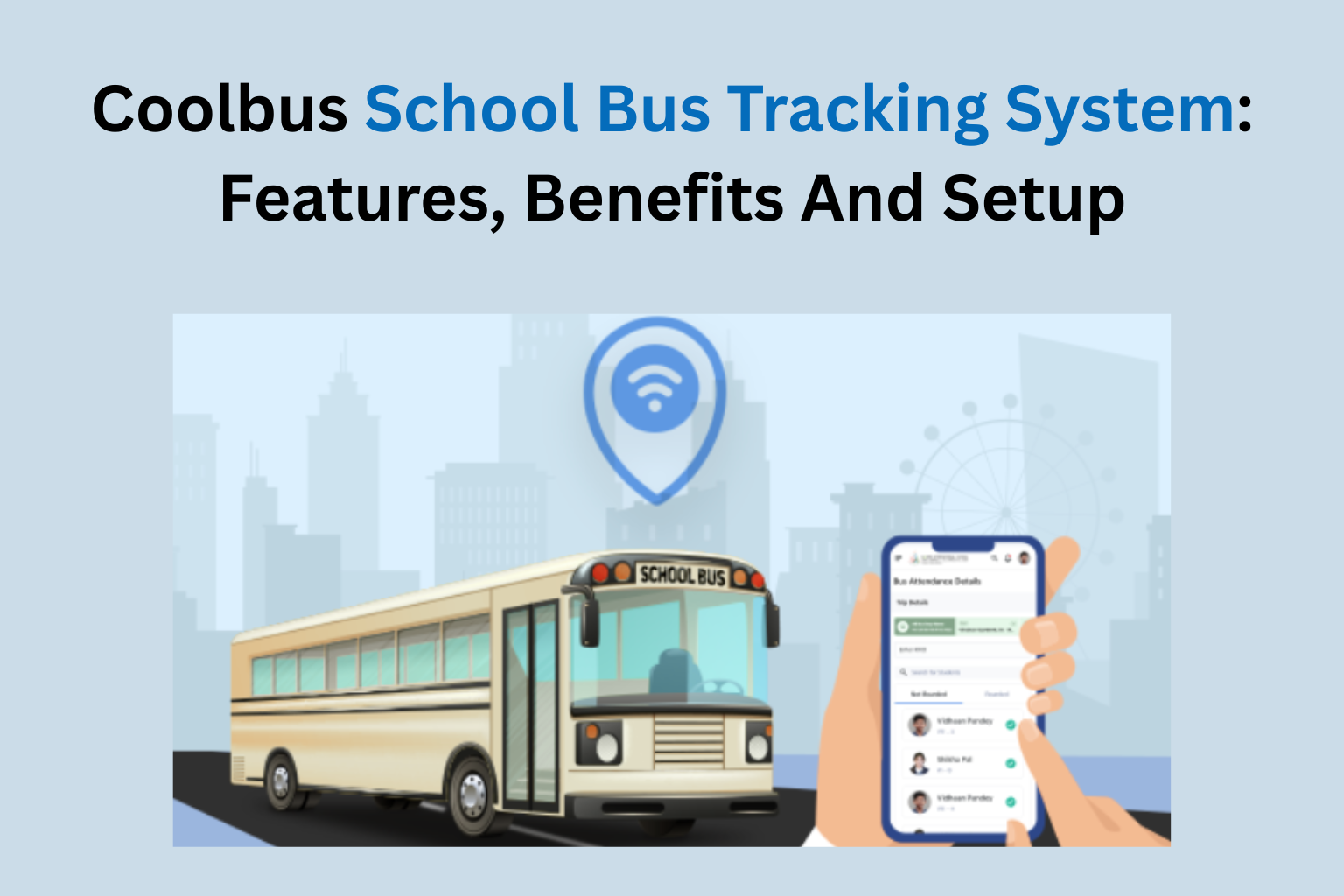
CoolBus by Aditi Tracking was built for that version. This guide covers what the system does, how it delivers value for schools, and what the setup process actually involves.
Why most schools need more than GPS
It is worth being direct about something before covering features. A GPS device fitted to a school bus is not a school bus tracking system. It is a location device. The distinction matters because many schools have invested in basic GPS tracking and found that it solved one problem – knowing approximately where the bus is – while leaving the broader operational picture unchanged.
Parents still call. Coordinators still manage manually. Driver behaviour still goes unmonitored. Attendance records are still reconstructed at the end of the day rather than captured in real time.
A full school bus tracking system connects multiple data points – location, attendance, driver behaviour, communication, and trip history – into a single operational picture that is accessible to the school, to parents, and to transport managers simultaneously. That is a different category of tool from a GPS tracker with a parent-facing app bolted on.
CoolBus is built as the former. Here is what that looks like in practice.
Core features of CoolBus
Real-time bus location and route monitoring
The foundation of any school bus tracking system is live location data. CoolBus provides this through a device fitted to the vehicle, transmitting continuous position updates to a cloud dashboard accessible by the school’s transport team and to a parent-facing mobile application.
The tracking runs throughout the active route. If a bus deviates from its assigned path – due to a road closure, an unauthorised stop, or a driver decision – the system flags the deviation and sends an alert to the transport manager. The alert arrives during the trip, not in a post-trip log.
Student boarding and alighting notifications
This is the feature that consistently matters most to Indian parents, and it is worth understanding why.
Parents are not primarily worried about the journey itself. They are worried about the handover moments. Did my child actually board the bus this morning? Did they get off at the right stop this afternoon? These two data points, confirmed in real time, are what convert a tracking app from something parents check occasionally into something they rely on daily.
CoolBus sends a push notification to the parent at the moment of boarding and again at alighting. The notification includes the location coordinates of the stop, the time, and the student’s name. It is automatic. It does not require the driver to do anything beyond operating the door as normal.
Driver behaviour monitoring
Speed violations, harsh braking, and extended idling are all captured and logged. The data is available to the school’s transport manager as part of the daily trip record. Patterns become visible over time – a driver who consistently speeds on a particular stretch of road, or who idles for extended periods at a stop that should take two minutes.
Schools that review this data regularly find that driver behaviour improves simply because the monitoring exists. Not because of disciplinary action. Because the ambiguity about whether behaviour is being measured disappears.
SOS alert system
A physical SOS button fitted inside the bus allows a driver or a responsible student to trigger an emergency alert. When activated, the alert reaches the school’s transport manager and designated contacts immediately, with the bus’s current GPS coordinates attached.
This feature rarely gets used. That is the point. Its value is in the confidence it creates – for schools, for parents, and for the students themselves – that there is a direct line to help if it is ever needed.
Fleet dashboard for transport managers
The school’s transport team accesses CoolBus through a web-based dashboard that shows all active routes simultaneously. Live positions, route adherence status, estimated arrival times at upcoming stops, and any active alerts are visible in a single view.
The dashboard eliminates the coordinator’s most exhausting task – fielding individual queries about where each bus is – because the answer is always available without a phone call. This alone changes the texture of a busy afternoon significantly.
Benefits that schools see after deployment
The value of a school bus tracking system like CoolBus tends to manifest in three layers, arriving at different points after go-live.
In the first two weeks:
- Parent call volume to the school office drops, often substantially. When parents can check the app, they do not call.
- Transport coordinators spend less time relaying information and more time managing exceptions.
- Drivers adjust behaviour on monitored routes, particularly around speed and stop duration.
Within the first term:
- Route anomalies and coverage gaps become visible and correctable. Informal route adjustments that accumulated over time get identified and either ratified or corrected.
- Boarding and alighting records provide a clean daily attendance log for bus travel that previously did not exist.
- Parent confidence in the school’s transport operation measurably improves. This shows up in the tone of parent communication and, in schools that track it, in admissions conversations where transport safety comes up.
Over the full academic year:
- Trip history data supports accountability. When a concern is raised about a specific journey, the school can pull the record within minutes and respond with facts rather than recollection.
- Driver performance trends inform vendor management conversations. A school with twelve months of driver behaviour data is in a very different position when renewing transport contracts than one operating on impression and memory.
What the setup process looks like
This is the part that schools most frequently want to understand before committing, and it is where CoolBus differs from the impression that technology deployments always create.
Setup involves four stages:
- Hardware installation – CoolBus devices are fitted to each vehicle in the fleet. This is handled by Aditi Tracking’s technical team and does not require the school to coordinate installers or manage the process independently. Installation per vehicle takes a few hours and does not require the vehicle to be taken off the road for more than a day.
- Route and roster configuration – The school’s routes, stops, and student assignments are loaded into the system. CoolBus handles this configuration as part of onboarding. Schools provide their existing route data; the team structures it within the platform.
- App distribution to parents – The parent-facing app is available on Android and iOS. Aditi Tracking provides the school with an onboarding guide designed for parents with varying levels of smartphone comfort. Schools that run a brief parent orientation session – even just a circular with a QR code and three-step instructions – see significantly higher adoption rates than those that simply share the app link.
- Staff training – The transport coordinator and relevant admin staff are trained on the dashboard. This is typically a two-hour session. The interface is direct enough that most coordinators are working independently within a day.
The full process from hardware installation to live operations typically runs across two to three weeks for a standard school fleet.
The case for doing this before the academic year starts
Deploying a school bus tracking system mid-year creates a transition problem. Routes are already running. Parents have existing habits. Drivers are used to the current setup. Introducing new hardware, a new app, and new notification patterns into an operation that is already in motion creates friction that is avoidable.
Schools that deploy CoolBus before the academic year begins start with a clean slate. Parents onboard before they have formed any expectations about how transport communication will work. Drivers start the year with the monitoring in place rather than experiencing it as a change to established routine. The coordinator enters the year with the system already familiar rather than learning it under pressure.
That timing advantage compounds. A school that ran its full previous year on CoolBus enters the next admissions cycle with a concrete, demonstrable answer to the question every informed parent now asks: how do you manage transport safety?

 Smart Fleet
 Cool Bus
 Clicktask
 CommutePulse
 Wastetrail