
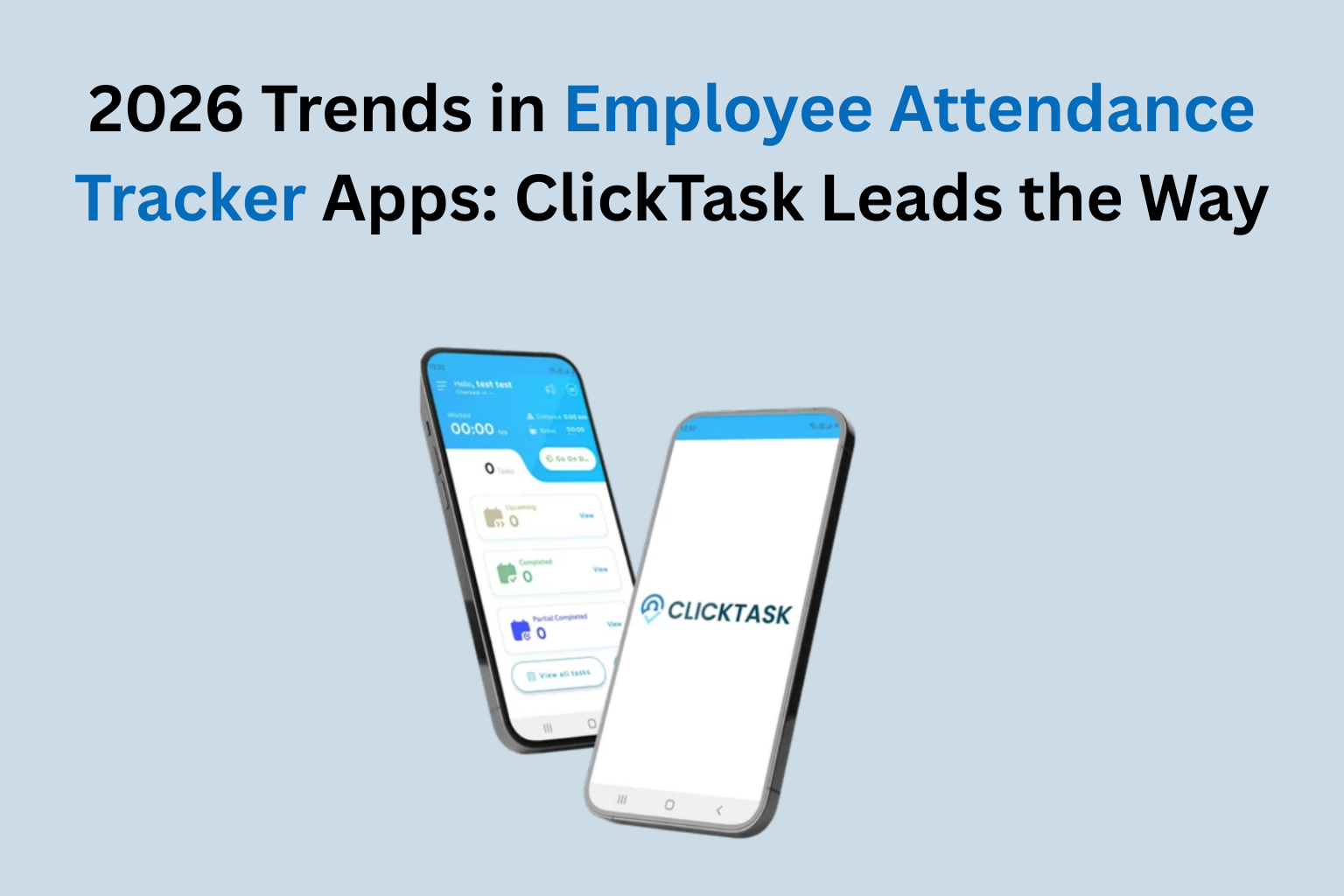
Every few years, a category of business software stops being optional and becomes infrastructure. Payroll software crossed that line in the 1990s. CRM crossed it in the 2010s. In 2026, the employee attendance tracker is crossing it, not because regulations are tightening, though they are, but because the workforce has changed in ways that make the old systems structurally incapable of doing the job.
Why 2026 Is the Inflection Year
The attendance register did not fail suddenly. It failed gradually, then all at once.
The gradual part happened over five years of workforce transformation: hybrid work normalized, field teams expanded, gig-adjacent roles blurred the line between employment and contracting, and the geography of where work happens stopped being predictable. The register, physical or digital, was designed for a workforce that arrived at one place and left from it. That workforce is now a minority.
The “all at once” part is happening now. Companies that held on to basic attendance tools through the transition are discovering in 2026 that the gap between recorded attendance and actual operational reality has become too wide to manage. The cost of that gap, in payroll inaccuracies, reimbursement fraud, productivity invisibility, and compliance risk, has crossed a threshold that makes the investment in modern systems undeniable.
The market response is a wave of employee attendance tracker applications, each claiming to be built for the new workforce reality. Most of them are old tools with new interfaces. A handful represent genuine operational advancement.
ClickTask by Aditi Tracking is in the second category. Not because of marketing claims, but because it was built on a decade of field tracking infrastructure before attendance became a trending software category.
Here is what the 2026 landscape looks like, and where it is going.
Trend One: Location Intelligence Replaces Location Proof
The Selfie Era Is Ending
Geo-tagged selfies were the 2020 answer to a 2015 problem. They added a location coordinate to attendance marking, which was progress. But they solved the wrong problem: proving the employee was somewhere at one moment, rather than understanding where the employee was across the working day.
In 2026, the leading employee attendance tracker applications are moving decisively away from moment-based verification toward continuous location intelligence. The question shifts from “was this person at the right location at 9 AM?” to “did this person’s movement across the day match their operational assignment?”
What Continuous Location Intelligence Enables
When an attendance system understands movement rather than moments, three things become possible that were not before:
First
Beat plan compliance becomes verifiable. A field executive assigned seven client visits can have each visit confirmed against GPS data, not just claimed in an end-of-day report.
Second
Productive hours become distinguishable from idle hours. Time spent at assigned locations is separated from time spent in transit, at unauthorized locations, or stationary in areas that do not correspond to any assignment.
Third
Reimbursement claims become auditable. Distance traveled is a GPS record, not a declaration. The gap between claimed and actual distance closes automatically.
ClickTask has operated on this model since its inception. The trend catching up to what Aditi Tracking built years ago is validation, not novelty.
Trend Two: Attendance Data Integrates With Task Data
The Attendance-Productivity Split Is Collapsing
For most of software history, attendance systems and task management systems lived in separate tools, managed by separate teams, and reviewed in separate meetings. HR owned attendance. Operations owned tasks. The connection between the two, whether the person who was marked present was actually doing what they were assigned to do, existed in no system at all.
In 2026, the most capable employee attendance tracker platforms are collapsing this split. Attendance and task data live in the same system, analyzed together, surfacing insights that neither dataset produces in isolation.
Why This Changes Performance Management
When attendance and task data integrate, performance management stops being a periodic review and becomes a continuous operational signal. A manager who sees that one field executive consistently completes 90 percent of assigned tasks while another consistently completes 55 percent, with location data confirming the gap, is not making a judgment call. They are reading an operational measurement.
That measurement changes conversations. It removes ambiguity. It makes performance feedback specific, fair, and actionable.
Trend Three: Compliance Automation Becomes Non-Negotiable
The Regulatory Environment in 2026
India’s labour compliance landscape is tightening across multiple fronts in 2026. The Code on Wages, the Occupational Safety, Health and Working Conditions Code, and state-level Shops and Establishments Act enforcement are all moving toward digital compliance records that can be produced on demand.
Companies that rely on manually compiled timesheets are discovering that compliance demonstration requires records they do not have in the format auditors expect. An employee attendance tracker that generates audit-ready compliance data automatically is shifting from a productivity tool to a legal necessity.
ClickTask generates attendance records with GPS coordinates, timestamps, and task completion data that satisfy digital compliance requirements. The records exist by default, not as a report compiled the week before an audit, but as a continuous operational log that is always current.
Overtime and Working Hours: The Audit Risk Nobody Is Preparing For
Overtime compliance is the specific area where companies with field teams are most exposed in 2026. Field employees whose actual working hours exceed statutory limits, but whose attendance systems only record shift times, not actual field hours, create payroll and compliance risk that most HR teams are not tracking.
An employee attendance tracker that logs actual field time against actual task completion closes this risk structurally. The record is accurate by construction, not by assumption.
Trend Four: Adoption Design Becomes a Competitive Differentiator
The Tool Nobody Uses Solves Nothing
There is a pattern in enterprise software that the attendance tracking category is finally confronting: the best-featured tool is not the most valuable tool. The most used tool is.
In 2026, the companies winning in field workforce management are not the ones with the most sophisticated backends. They are the ones whose field teams actually use the system every day without friction, complaint, or workaround.
Adoption design, the deliberate engineering of a user experience that field employees use naturally, is becoming the primary differentiator in the employee attendance tracker market.
ClickTask’s mobile interface is built on this principle. Three taps for attendance marking. Automatic task receipt. Simple completion confirmation. The complexity is on the manager’s dashboard. The field executive’s experience is clean, fast, and frictionless.
Aditi Tracking learned this lesson through 14 years of deploying tracking hardware across field operations in India. The devices that get disabled, covered, or “forgotten” are the ones that feel like impositions. The systems that become invisible infrastructure are the ones that fit naturally into how field teams already work.
Offline Capability: The India-Specific Requirement
One adoption barrier that most global attendance platforms underestimate is connectivity. Indian field operations cross territories where 4G coverage is inconsistent, and any system that requires network connectivity to function will fail precisely when the most important field work is happening.
ClickTask handles this by logging data locally when connectivity drops and syncing when the network returns. The attendance record and task completion data remain complete regardless of network conditions. For a company running field operations across semi-urban and rural territories in India, this is not a nice-to-have. It is a functional requirement.
What 2026 Actually Requires From Workforce Monitoring
Stepping back from individual trends, a single requirement ties all of them together: the employee attendance tracker of 2026 must be an operational tool, not an HR tool.
HR tools record. Operational tools inform decisions.
The distinction matters enormously for what a company extracts from the investment. A system used primarily by HR to verify payroll eligibility captures a small fraction of available value. A system used by operations managers to understand field performance, by HR for compliance, and by field executives to receive and confirm assignments, that system reshapes how the company runs.
ClickTask was built as an operational tool from the beginning. Aditi Tracking‘s experience is in telematics, in building systems that make fleets and field operations measurably more efficient. That orientation shapes ClickTask in ways that purpose-built HR tools cannot replicate.
The attendance tracker that leads in 2026 is not the one with the most features. It is the one that becomes indispensable to the people doing the actual work. That is a harder standard to meet. It is also the only one worth meeting.
 Fleet Management
 Cool Bus
 Clicktask
 CommutePulse
 Wastetrail